Join Our JEE Preparation Group
Prep with like-minded aspirants; Get access to free daily tests and study material.
Sign in
Please select an account to continue using cracku.in
↓ →
Join Our JEE Preparation Group
Prep with like-minded aspirants; Get access to free daily tests and study material.
LiAlH4 is a strong nucleophilic reducing agent that attacks the carbonyl carbon of carboxylic-acid derivatives by the nucleophilic acyl-substitution mechanism.
For such reactions, the rate depends mainly on the quality of the leaving group $$Y^-$$ in the tetrahedral intermediate: better leaving groups give faster reactions. The general order of leaving-group ability (best → worst) is: $$Cl^- \gt RCOO^- \gt RO^- \gt NH_2^-$$.
Matching each derivative with its leaving group:
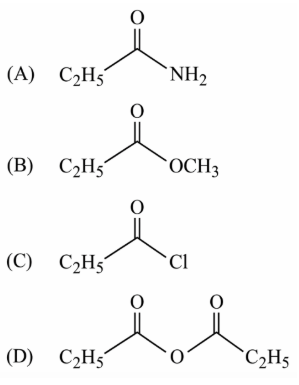
$$C_2H_5COCl$$ (acid chloride, C) → leaves $$Cl^-$$ (best)
$$(C_2H_5CO)_2O$$ (acid anhydride, D) → leaves $$RCOO^-$$
$$C_2H_5COOCH_3$$ (ester, B) → leaves $$RO^-$$
$$C_2H_5CONH_2$$ (amide, A) → leaves $$NH_2^-$$ (worst)
Therefore the reactivity order toward LiAlH4 is
$$\text{amide (A)} \lt \text{ester (B)} \lt \text{anhydride (D)} \lt \text{acid chloride (C)}$$
Hence, the increasing order asked in the question is: (A) < (B) < (D) < (C).
Option C matches this sequence.
Final answer: Option C
Was this solution helpful?
Create a FREE account and get:
_1.webp)

Educational materials for JEE preparation

Ask our AI anything

AI can make mistakes. Please verify important information.
AI can make mistakes. Please verify important information.