Join Our JEE Preparation Group
Prep with like-minded aspirants; Get access to free daily tests and study material.
Sign in
Please select an account to continue using cracku.in
↓ →
Join Our JEE Preparation Group
Prep with like-minded aspirants; Get access to free daily tests and study material.
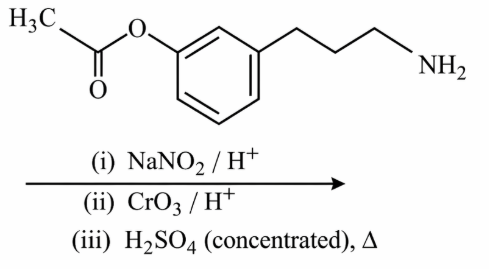
We begin with an aromatic amine. The reaction sequence given is
$$\text{(i) }NaNO_2/H^+, \qquad \text{(ii) }CrO_3/H^+, \qquad \text{(iii) conc.\;}H_2SO_4\text{,\;}\Delta$$
and we must work out, one stage at a time, what each reagent does to the substrate.
Step (i) - Diazotisation followed by hydrolytic replacement. For an aromatic amine, the well-known diazotisation reaction is
$$\text{Ar-NH}_2 + NaNO_2 + 2H^+ \;\longrightarrow\; \text{Ar-N}_2^+ + Na^+ + 2H_2O.$$
The diazonium ion so formed is not isolated under these aqueous acidic conditions; it is immediately displaced by water because diazonium is an extremely good leaving group. The net result is
$$\text{Ar-N}_2^+ + H_2O \;\longrightarrow\; \text{Ar-OH} + N_2\uparrow + H^+.$$
Thus, after the first reagent, the -NH2 group of the starting molecule has been converted cleanly to an -OH group. Consequently we are now in possession of an ortho-hydroxy aryl compound in which the side-chain attached to the same ring remains unaltered.
Step (ii) - Oxidation of the benzylic side chain. The second reagent, $$CrO_3/H^+,$$ is Jones reagent - a strong, acidic, chromium(VI) oxidising agent. A benzylic alkyl side chain is particularly susceptible to such oxidation; every hydrogen attached to the benzylic carbon is ultimately removed, and the chain is converted into a carboxylic acid. Symbolically, for a two-carbon chain we write
$$ \text{Ar-CH}_2CH_3 \overset{CrO_3}{\underset{\;H^+\;}{\rightarrow}} \text{Ar-CH}_2COOH.$$
Therefore, after this oxidation the molecule has become an ortho-hydroxyphenylacetic acid. Notice carefully that the aromatic ring now bears two essential functional groups in adjacent positions - a phenolic -OH and a -CH2COOH group. This juxtaposition sets the stage for an intramolecular Friedel-Crafts acylation.
Step (iii) - Intramolecular Friedel-Crafts acylation. Concentrated sulphuric acid at high temperature protonates the carboxylic acid, generating the acylium ion that actually performs the electrophilic attack. The general sequence is
$$\text{R-CH}_2COOH + H^+ \;\longrightarrow\; \text{R-CH}_2C(OH)_2^+ \;\longrightarrow\; \text{R-CH}_2CO^+ + H_2O.$$
The acylium ion $$\text{R-CH}_2CO^+$$ is an excellent electrophile. In the present molecule it is tethered to the same aromatic ring through the -CH2 bridge. The ring therefore attacks its own acylium carbon at the position that is ortho to the bridge, closing a five-membered ring. Loss of a proton from the ring restores aromaticity, while the acylium oxygen remains as a carbonyl. The overall outcome is the formation of an indan-1-one skeleton carrying a hydroxyl substituent on the aromatic ring:
$$ \begin{array}{c} \text{o-HO-C}_6H_4\text{-CH}_2COOH \; \overset{conc.\;H_2SO_4}{\underset{\;\; \Delta\;\;}{\rightarrow}} \; \text{7-hydroxy-1-indanone}. \end{array} $$
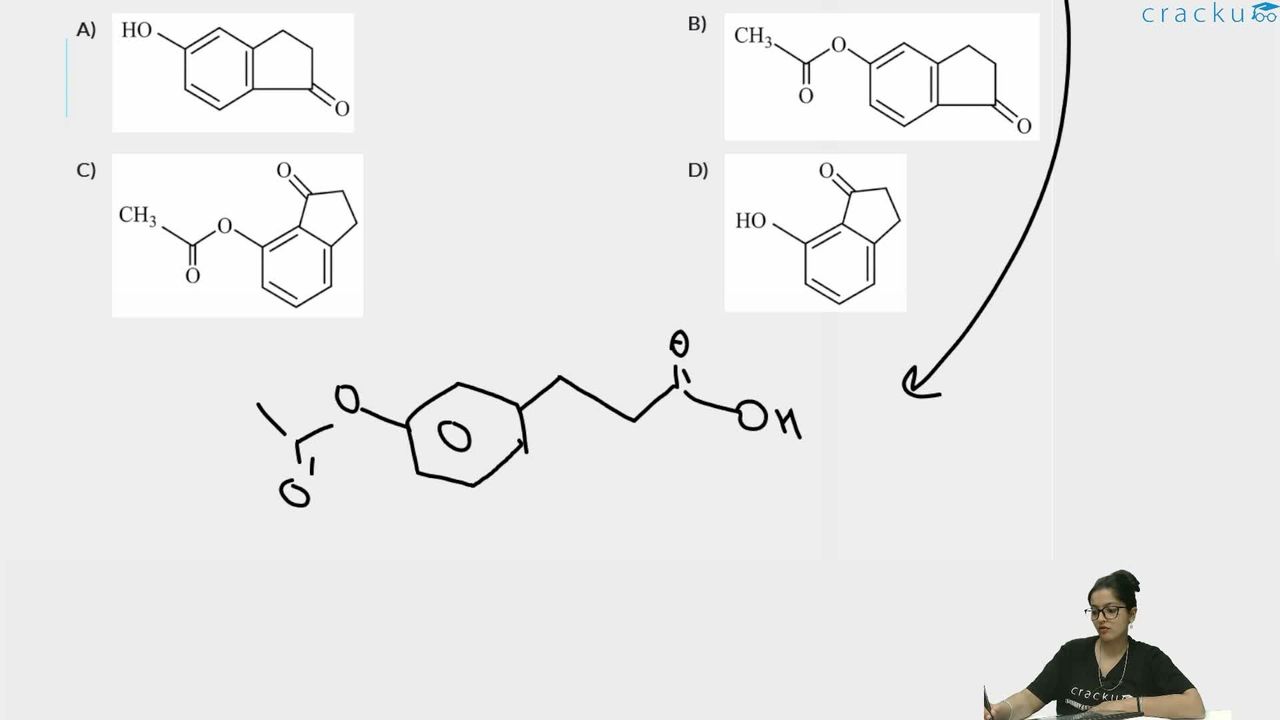
The newly formed five-membered fused ring (the “indan” part) contains a ketone at the bridgehead carbon (position 1), and the phenolic -OH that was introduced in the very first step is still present at the para-like (actually 7-) position of the bicyclic system. Among the options supplied, only Option 1 depicts exactly that structure - an HO-substituted indanone.
Hence, the correct answer is Option 1.
Was this solution helpful?
Click on the Email ☝️ to Watch the Video Solution
Create a FREE account and get:
_1.webp)

Educational materials for JEE preparation

Ask our AI anything

AI can make mistakes. Please verify important information.
AI can make mistakes. Please verify important information.