
Join Our JEE Preparation Group
Prep with like-minded aspirants; Get access to free daily tests and study material.
Sign in
Please select an account to continue using cracku.in
↓ →
Join Our JEE Preparation Group
Prep with like-minded aspirants; Get access to free daily tests and study material.
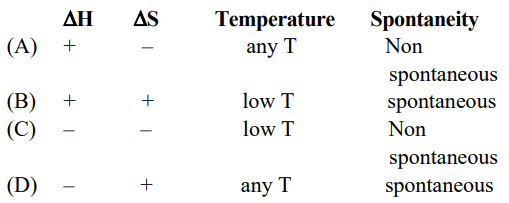
We need to determine the correct statements regarding the effect of temperature on the spontaneity of chemical reactions based on the Gibbs free energy relationship:
$$\Delta G = \Delta H - T\Delta S$$
For a reaction to be spontaneous, the change in Gibbs free energy must be negative ($$\Delta G < 0$$). If $$\Delta G > 0$$ at a given temperature, the reaction is non-spontaneous at that temperature.
Statement (A): $$\Delta H = (+)$$, $$\Delta S = (-)$$, at any $$T$$ $$\rightarrow$$ Non-spontaneous
$$\Delta G = (+) - T(-)\ = (+) + (+)\ = (+)$$. Since $$\Delta G$$ remains positive at all temperatures, the reaction is permanently non-spontaneous.
Statement (B): $$\Delta H = (+)$$, $$\Delta S = (+)$$, at low $$T$$ $$\rightarrow$$ Spontaneous
When both are positive, $$\Delta G = (+) - T(+)$$. At low temperatures, the magnitude of the $$T\Delta S$$ term is small, meaning the positive $$\Delta H$$ dominates and makes $$\Delta G > 0$$ (non-spontaneous). It only becomes spontaneous ($$\Delta G < 0$$) at high temperatures.
Statement (C): $$\Delta H = (-)$$, $$\Delta S = (-)$$, at low $$T$$ $$\rightarrow$$ Non-spontaneous
When both are negative, $$\Delta G = (-) - T(-)\ = (-) + T(+)$$. At low temperatures, the magnitude of the positive $$T\Delta S$$ block is small, so the negative $$\Delta H$$ term dominates, making $$\Delta G < 0$$ (spontaneous). At high temperatures, the positive $$T\Delta S$$ factor takes over, making it non-spontaneous.
Statement (D): $$\Delta H = (-)$$, $$\Delta S = (+)$$, at any $$T$$ $$\rightarrow$$ Spontaneous
$$\Delta G = (-) - T(+)\ = (-) + (-)\ = (-)$$. Since $$\Delta G$$ remains negative at all temperatures, the reaction is permanently spontaneous.
Looking at the criteria requested in the evaluation, the assertions marked as (B) and (C) correctly present the cases where the spontaneous nature changes under the influence of temperature variations.
Answer: Option A — (B) and (C) only
Was this solution helpful?
Create a FREE account and get:
Educational materials for JEE preparation

Ask our AI anything

AI can make mistakes. Please verify important information.
AI can make mistakes. Please verify important information.

_1.webp)
