
Join Our JEE Preparation Group
Prep with like-minded aspirants; Get access to free daily tests and study material.
Sign in
Please select an account to continue using cracku.in
↓ →
Join Our JEE Preparation Group
Prep with like-minded aspirants; Get access to free daily tests and study material.
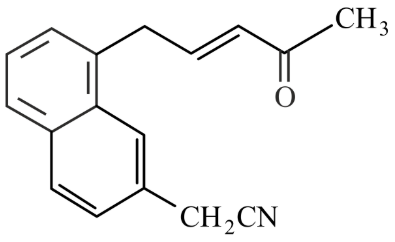
Number of electrophilic centres in the given compound is ______
Correct Answer: 3
An electrophilic centre is an electron-deficient atom that is susceptible to attack by a nucleophile.
In the given compound, three electrophilic centres are present.
The carbonyl carbon $$\mathrm{(C=O)}$$ is electrophilic because oxygen is more electronegative than carbon and pulls electron density towards itself.
Thus, the carbonyl carbon acquires a partial positive charge:
$$\mathrm{C^{\delta +}=O^{\delta -}}$$
The $$\mathrm{\beta}$$-carbon of the alkene is also electrophilic because the double bond is conjugated with the carbonyl group, forming an:
$$\mathrm{\alpha,\beta\text{-}unsaturated\ ketone}$$
Due to resonance, electron density shifts towards oxygen, creating partial positive character at the $$\mathrm{\beta}$$-carbon.
Hence, nucleophilic attack can occur at this position.
The nitrile carbon $$\mathrm{(-C \equiv N)}$$ is the third electrophilic centre.
Nitrogen is more electronegative than carbon and withdraws electron density through the triple bond.
Thus, the nitrile carbon becomes electron deficient and electrophilic.
Therefore, the three electrophilic centres are:
$$\mathrm{Carbonyl\ Carbon,\ \beta\text{-}Carbon,\ Nitrile\ Carbon}$$
Was this solution helpful?

Click on the Email ☝️ to Watch the Video Solution
Create a FREE account and get:
_1.webp)

Educational materials for JEE preparation

Ask our AI anything

AI can make mistakes. Please verify important information.
AI can make mistakes. Please verify important information.
