
Join Our JEE Preparation Group
Prep with like-minded aspirants; Get access to free daily tests and study material.
Sign in
Please select an account to continue using cracku.in
↓ →
Join Our JEE Preparation Group
Prep with like-minded aspirants; Get access to free daily tests and study material.
Let $$n > 2$$ be an integer. Suppose that there are $$n$$ Metro stations in a city located around a circular path. Each pair of the nearest stations is connected by a straight track only. Further, each pair of the nearest station is connected by blue line, whereas all remaining pairs of stations are connected by red line. If number of red lines is 99 times the number of blue lines, then the value of $$n$$ is:
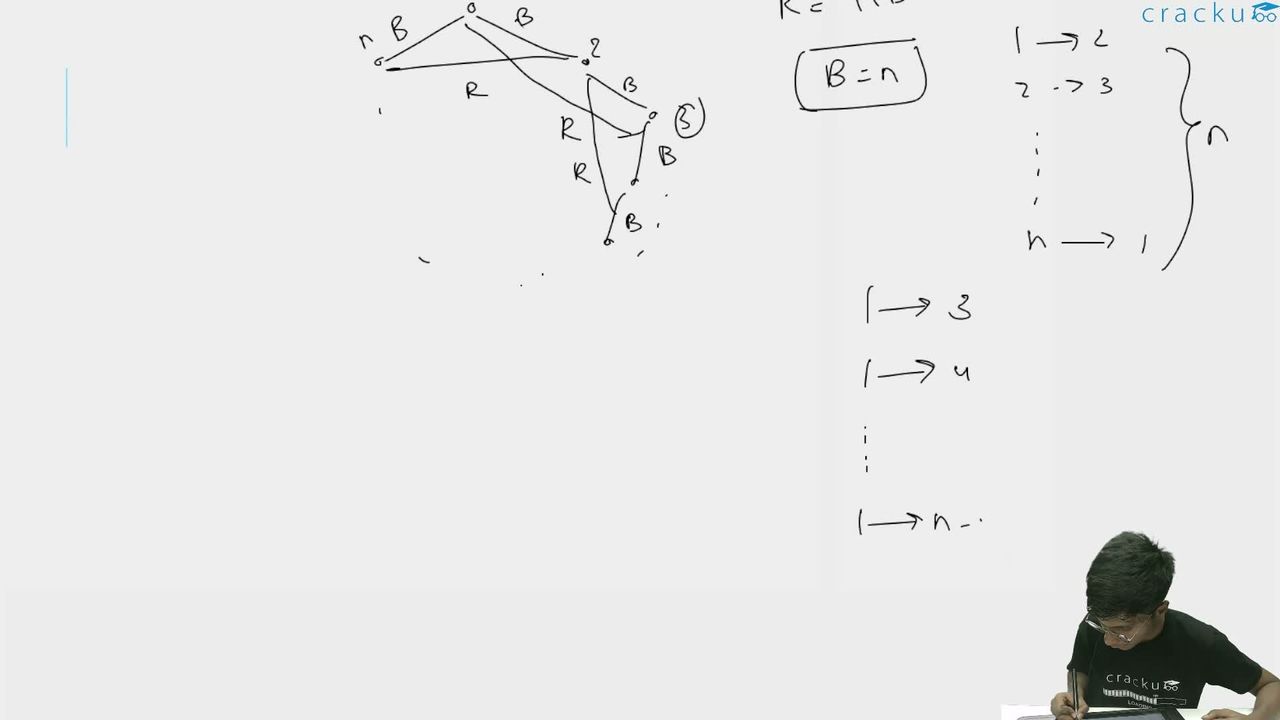
We have $$n$$ Metro stations placed on a circle, with $$n > 2$$. For any two stations we draw exactly one straight track, so overall the network is the complete graph on $$n$$ vertices.
Among these tracks, those joining the two stations that are next to each other on the circle are declared blue. Because the stations form a single closed polygon, every station is adjacent to exactly two neighbours, but every such edge is counted only once. Hence the number of blue tracks equals the number of sides of the polygon, namely
$$\text{Blue lines}=n.$$
All the other tracks, i.e. those whose ends are not nearest neighbours on the circle, are coloured red. Let us count how many tracks there are altogether. In a complete graph on $$n$$ vertices, the number of unordered pairs of vertices (and hence the number of tracks) is given by the combination formula
$$\binom{n}{2}= \frac{n(n-1)}{2}.$$
Therefore
$$\text{Total tracks}= \frac{n(n-1)}{2}.$$ $$\text{Red lines}= \text{Total tracks}-\text{Blue lines}= \frac{n(n-1)}{2}-n.$$
The condition given in the question says that the number of red lines is 99 times the number of blue lines, that is,
$$\frac{n(n-1)}{2}-n = 99\,n.$$
Now we solve this equation step by step. First clear the fraction by multiplying both sides by 2:
$$n(n-1) - 2n = 198\,n.$$
Expand the left side:
$$n^2 - n - 2n = 198\,n.$$
Combine like terms on the left:
$$n^2 - 3n = 198\,n.$$
Bring the right‐hand side to the left:
$$n^2 - 3n - 198\,n = 0,$$ $$n^2 - 201\,n = 0.$$
Factor out $$n$$:
$$n\,(n-201)=0.$$
Since we are told $$n>2$$, the factor $$n=0$$ is impossible. Hence we must have
$$n-201 = 0 \quad\Longrightarrow\quad n = 201.$$
Hence, the correct answer is Option A.
Was this solution helpful?
Click on the Email ☝️ to Watch the Video Solution
Create a FREE account and get:
_1.webp)

Educational materials for JEE preparation

Ask our AI anything

AI can make mistakes. Please verify important information.
AI can make mistakes. Please verify important information.


