
Join Our JEE Preparation Group
Prep with like-minded aspirants; Get access to free daily tests and study material.
Sign in
Please select an account to continue using cracku.in
↓ →
Join Our JEE Preparation Group
Prep with like-minded aspirants; Get access to free daily tests and study material.
Electrons in a cathode ray tube have been emitted with a velocity of 1000 ms$$^{-1}$$. The number of following statements which is/are true about the emitted radiation is
Given: h = 6 $$\times$$ 10$$^{-34}$$Js, m$$_e$$ = 9 $$\times$$ 10$$^{-31}$$ kg
(A) The deBroglie wavelength of the electron emitted is 666.67 nm
(B) The characteristic of electrons emitted depend upon the material of the electrodes of the cathode ray tube.
(C) The cathode rays start from cathode and move towards anode.
(D) The nature of the emitted electrons depends on the nature of the gas present in cathode ray tube..
Correct Answer: 2
We have velocity of electrons $$v = 1000$$ m/s, $$h = 6 \times 10^{-34}$$ Js, $$m_e = 9 \times 10^{-31}$$ kg.
(A) The de Broglie wavelength of the electron emitted is 666.67 nm.
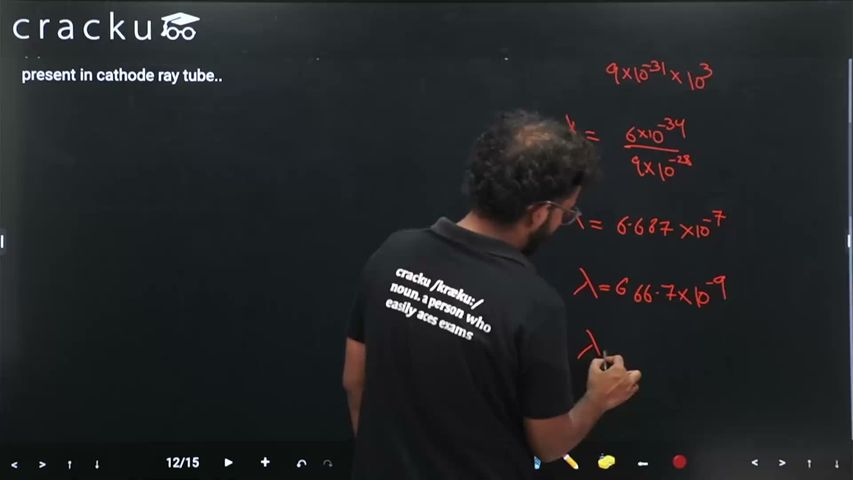
$$\lambda = \frac{h}{m_e v} = \frac{6 \times 10^{-34}}{9 \times 10^{-31} \times 1000} = \frac{6 \times 10^{-34}}{9 \times 10^{-28}} = 6.67 \times 10^{-7} \text{ m} = 666.7 \text{ nm}$$
This is TRUE.
(B) The characteristics of electrons emitted depend upon the material of the electrodes. This is FALSE — the properties of cathode rays (electrons) are independent of the electrode material, since electrons are fundamental particles with the same properties regardless of the source.
(C) The cathode rays start from cathode and move towards anode. This is TRUE — cathode rays are streams of electrons emitted from the cathode and accelerated towards the anode.
(D) The nature of the emitted electrons depends on the nature of the gas present. This is FALSE — the properties of electrons are independent of the gas used in the cathode ray tube.
So, the number of true statements is 2 (A and C). Hence, the answer is $$2$$.
Was this solution helpful?
Click on the Email ☝️ to Watch the Video Solution
Create a FREE account and get:
_1.webp)

Educational materials for JEE preparation

Ask our AI anything

AI can make mistakes. Please verify important information.
AI can make mistakes. Please verify important information.
