Join Our JEE Preparation Group
Prep with like-minded aspirants; Get access to free daily tests and study material.
Sign in
Please select an account to continue using cracku.in
↓ →
Join Our JEE Preparation Group
Prep with like-minded aspirants; Get access to free daily tests and study material.
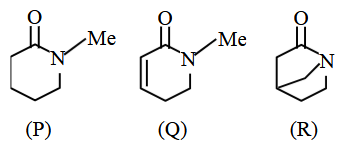
The basicity of these molecules depends on the availability of the lone pair of electrons on the nitrogen atom. A more localized lone pair is more readily available for protonation and therefore results in higher basicity.
For Molecule (R):
Molecule (R) is a bridged bicyclic lactam in which the nitrogen atom is located at the bridgehead position.
According to Bredt's rule, a double bond cannot be formed at the bridgehead of a small bicyclic system because such a structure would introduce severe ring strain.
As a result, the usual amide resonance involving delocalization of the nitrogen lone pair into the carbonyl group cannot occur.
Since the lone pair remains localized on the nitrogen atom, it is readily available for protonation. Consequently, molecule (R) behaves similarly to an aliphatic tertiary amine and is the most basic among the three compounds.
For Molecule (P):
This is a saturated lactam in which the nitrogen lone pair undergoes normal amide resonance with the adjacent carbonyl group.
The resonance may be represented as
$$N-C=O \longleftrightarrow N^+=C-O^-.$$
Because the lone pair is significantly delocalized into the carbonyl system, its availability for protonation is greatly reduced, making molecule (P) weakly basic.
For Molecule (Q):
Molecule (Q) is an $$\alpha,\beta$$-unsaturated amide containing a carbon-carbon double bond conjugated with the carbonyl group.
The $$\pi$$ electrons of the alkene also participate in conjugation with the carbonyl group:
$$C=C-C=O \longleftrightarrow {}^+C-C=C-O^-.$$
This additional conjugation supplies electron density to the carbonyl oxygen, reducing the extent to which the nitrogen lone pair must delocalize into the carbonyl group.
Consequently, the nitrogen atom retains a greater amount of localized electron density than in molecule (P), making molecule (Q) more basic than molecule (P).
Therefore,
Hence, the correct order of basicity is
$$R > Q > P.$$
Was this solution helpful?
Create a FREE account and get:
_1.webp)

Educational materials for JEE preparation

Ask our AI anything

AI can make mistakes. Please verify important information.
AI can make mistakes. Please verify important information.