
Join Our JEE Preparation Group
Prep with like-minded aspirants; Get access to free daily tests and study material.
Sign in
Please select an account to continue using cracku.in
↓ →
Join Our JEE Preparation Group
Prep with like-minded aspirants; Get access to free daily tests and study material.
The incorrect relationship in the following pairs in relation to ionisation enthalpies is :
Ionisation enthalpy (IE) of an ion is the energy required to remove one electron from that ion and convert it into the next higher-charged ion.
Two main points decide the magnitude of an IE:
(i) Higher positive charge on the ion → stronger attraction for the remaining electrons → larger IE.
(ii) Extra stability of half-filled $$d^{5}$$ or completely filled $$d^{10}$$ subshells → larger IE, because removing an electron disturbs that stable configuration.
Let us write the ground-state electronic configurations (after removing the outer $$4s$$ electrons first) and analyse every pair.
Case A:
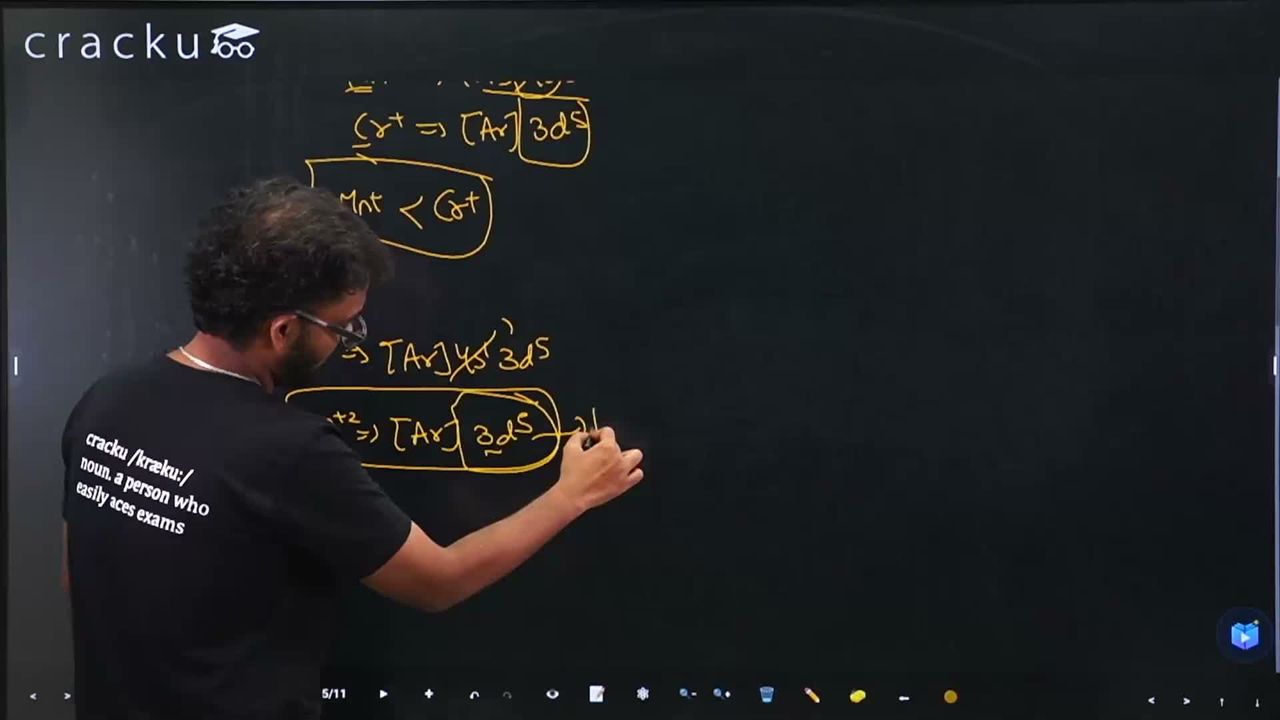
$$Mn^{+} : [Ar]\;3d^{5}\,4s^{1}$$
$$Cr^{+} : [Ar]\;3d^{5}$$
To ionise $$Mn^{+}$$ we remove the remaining $$4s^{1}$$ electron, reaching the very stable $$[Ar]\;3d^{5}$$ state. This is easy.
To ionise $$Cr^{+}$$ we would have to disturb the already stable $$3d^{5}$$ set. This is difficult.
Hence $$IE(Mn^{+}) \lt IE(Cr^{+})$$, the given inequality is correct.
Case B:
Successive ionisation energies always rise because the nuclear charge experienced per electron increases after each removal. Therefore $$IE(Mn^{2+})$$ (third IE of Mn) is definitely greater than $$IE(Mn^{+})$$ (second IE of Mn).
So $$IE(Mn^{+}) \lt IE(Mn^{2+})$$, the given inequality is correct.
Case C:
$$Fe^{2+} : [Ar]\;3d^{6}$$
$$Fe^{3+} : [Ar]\;3d^{5}$$ (half-filled, extra stable)
Removing one electron from $$Fe^{2+}$$ produces the very stable half-filled configuration of $$Fe^{3+}$$, so $$IE(Fe^{2+})$$ is comparatively low.
Removing one more electron from $$Fe^{3+}$$ would break that half-filled stability, so $$IE(Fe^{3+})$$ is very high.
Therefore $$IE(Fe^{2+}) \lt IE(Fe^{3+})$$, the given inequality is correct.
Case D:
$$Mn^{2+} : [Ar]\;3d^{5}$$ (half-filled, highly stable)
$$Fe^{2+} : [Ar]\;3d^{6}$$
To ionise $$Mn^{2+}$$ we would have to disturb the stable $$3d^{5}$$ arrangement, so $$IE(Mn^{2+})$$ is very large.
To ionise $$Fe^{2+}$$ we move from $$3d^{6} \rightarrow 3d^{5}$$, attaining the half-filled stability; this process needs less energy.
Hence $$IE(Mn^{2+}) \gt IE(Fe^{2+})$$.
The statement given in Option D, $$Mn^{2+} \lt Fe^{2+}$$, is opposite to the actual order and is therefore incorrect.
Among the four options, only Option D shows a wrong relationship of ionisation enthalpies.
Final answer: Option D (4).
Was this solution helpful?
Click on the Email ☝️ to Watch the Video Solution
Create a FREE account and get:
_1.webp)

Educational materials for JEE preparation

Ask our AI anything

AI can make mistakes. Please verify important information.
AI can make mistakes. Please verify important information.
