
Join Our JEE Preparation Group
Prep with like-minded aspirants; Get access to free daily tests and study material.
Sign in
Please select an account to continue using cracku.in
↓ →
Join Our JEE Preparation Group
Prep with like-minded aspirants; Get access to free daily tests and study material.
Amongst the following the number of oxide(s) which are paramagnetic in nature is ______
$$Na_2O, KO_2, NO_2, N_2O, ClO_2, NO, SO_2, Cl_2O$$
Correct Answer: 4
To determine whether an oxide is paramagnetic or diamagnetic, we check for the presence of unpaired electrons.
Species containing unpaired electrons are paramagnetic.
Species with all electrons paired are diamagnetic.
$$\mathrm{Na_2O}$$
Contains:
$$\mathrm{Na^+ \ and\ O^{2-}}$$
The oxide ion has completely filled orbitals:
$$\mathrm{O^{2-} : 1s^2\ 2s^2\ 2p^6}$$
All electrons are paired.
Hence:
$$\mathrm{Na_2O \ is\ diamagnetic}$$
$$\mathrm{KO_2}$$
Contains the superoxide ion:
$$\mathrm{O_2^-}$$
The superoxide ion possesses one unpaired electron in the antibonding $$\mathrm{\pi^*}$$ orbital.
Hence:
$$\mathrm{KO_2 \ is\ paramagnetic}$$
$$\mathrm{NO_2}$$
Total valence electrons:
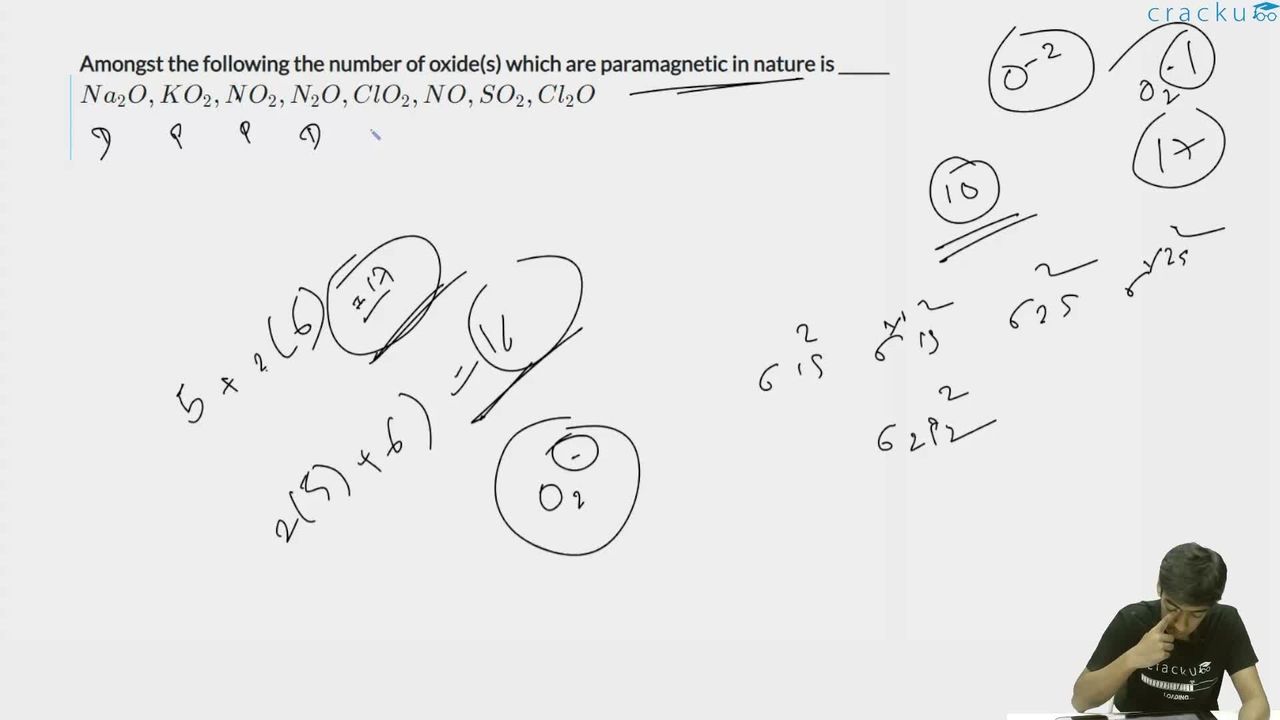
$$\mathrm{= 5 + 2(6) = 17}$$
Odd number of electrons ⇒ one unpaired electron.
Hence:
$$\mathrm{NO_2 \ is\ paramagnetic}$$
$$\mathrm{ClO_2}$$
Total valence electrons:
$$\mathrm{= 7 + 2(6) = 19}$$
Odd number of electrons ⇒ one unpaired electron.
Hence:
$$\mathrm{ClO_2 \ is\ paramagnetic}$$
$$\mathrm{NO}$$
Total valence electrons:
$$\mathrm{= 5 + 6 = 11}$$
Odd number of electrons ⇒ one unpaired electron.
Hence:
$$\mathrm{NO \ is\ paramagnetic}$$
$$\mathrm{N_2O}$$
Total valence electrons:
$$\mathrm{= 2(5) + 6 = 16}$$
All electrons are paired.
Hence:
$$\mathrm{N_2O \ is\ diamagnetic}$$
$$\mathrm{SO_2}$$
Total valence electrons:
$$\mathrm{= 6 + 2(6) = 18}$$
All electrons are paired.
Hence:
$$\mathrm{SO_2 \ is\ diamagnetic}$$
$$\mathrm{Cl_2O}$$
Total valence electrons:
$$\mathrm{= 2(7) + 6 = 20}$$
All electrons are paired.
Hence:
$$\mathrm{Cl_2O \ is\ diamagnetic}$$
Paramagnetic species:
$$\mathrm{KO_2,\ NO_2,\ ClO_2,\ NO}$$
Total number of paramagnetic oxides:
$$\boxed{\mathrm{4}}$$
Was this solution helpful?
Click on the Email ☝️ to Watch the Video Solution
Create a FREE account and get:
_1.webp)

Educational materials for JEE preparation

Ask our AI anything

AI can make mistakes. Please verify important information.
AI can make mistakes. Please verify important information.
