
Join Our JEE Preparation Group
Prep with like-minded aspirants; Get access to free daily tests and study material.
Sign in
Please select an account to continue using cracku.in
↓ →
Join Our JEE Preparation Group
Prep with like-minded aspirants; Get access to free daily tests and study material.
Two satellites $$A$$ and $$B$$ of masses 200 kg and 400 kg are revolving round the earth at height of 600 km and 1600 km respectively. If $$T_A$$ and $$T_B$$ are the time periods of $$A$$ and $$B$$ respectively then the value of $$T_B - T_A$$:
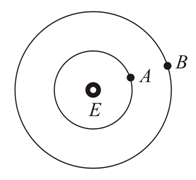
[Given: radius of earth = 6400 km, mass of earth = $$6 \times 10^{24}$$ kg]
The time period ($$T$$) of a satellite revolving in a circular orbit around the Earth depends strictly on its orbital radius ($$r = R + h$$) and the mass of the Earth ($$M$$). It is completely independent of the satellite's own mass:
$$T = \frac{2\pi r^{3/2}}{\sqrt{GM}} = 2\pi \sqrt{\frac{r^3}{GM}}$$
Let's pre-calculate the constant value $$2\pi \frac{1}{\sqrt{GM}}$$ using SI units:
The total orbital radius for satellite $$A$$ is:
$$r_A = R + h_A = 6400 \,\, \text{km} + 600 \,\, \text{km} = 7000 \,\, \text{km} = 7 \times 10^6 \,\, \text{m}$$
Substitute this value into the time period equation:
$$T_A = 2\pi \sqrt{\frac{(7 \times 10^6)^3}{2 \times 10^7 \times 2 \times 10^7}} = \frac{2\pi}{2 \times 10^7} \times (7 \times 10^6)^{1.5}$$
$$T_A \approx 3.14 \times 10^{-7} \times 1.852 \times 10^{10} \approx 5815 \,\, \text{s}$$
The total orbital radius for satellite $$B$$ is:
$$r_B = R + h_B = 6400 \,\, \text{km} + 1600 \,\, \text{km} = 8000 \,\, \text{km} = 8 \times 10^6 \,\, \text{m}$$
Substitute this value into the time period equation:
$$T_B = \frac{2\pi}{2 \times 10^7} \times (8 \times 10^6)^{1.5}$$
$$T_B \approx 3.14 \times 10^{-7} \times 2.263 \times 10^{10} \approx 7106 \,\, \text{s}$$
Subtract the two time values to find the final interval:
$$\Delta T = T_B - T_A = 7106 \,\, \text{s} - 5815 \,\, \text{s} = 1291 \,\, \text{s} \approx 1.33 \times 10^3 \,\, \text{s}$$
Correct Option: C ($$1.33 \times 10^3 \,\, \text{s}$$)
Was this solution helpful?
Create a FREE account and get:
_1.webp)

Educational materials for JEE preparation

Ask our AI anything

AI can make mistakes. Please verify important information.
AI can make mistakes. Please verify important information.
