
Join Our JEE Preparation Group
Prep with like-minded aspirants; Get access to free daily tests and study material.
Sign in
Please select an account to continue using cracku.in
↓ →
Join Our JEE Preparation Group
Prep with like-minded aspirants; Get access to free daily tests and study material.
A solid sphere of radius $$R$$ gravitationally attracts a particle placed at $$3R$$ from its centre with a force $$F_1$$. Now a spherical cavity of radius $$\frac{R}{2}$$ is made in the sphere (as shown in figure) and the force becomes $$F_2$$. The value of $$F_1 : F_2$$ is:
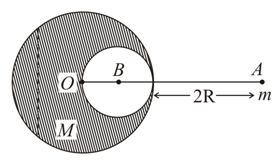
Let the total uniform mass of the initial complete, solid sphere of radius $$R$$ be $$M$$. The particle of mass $$m$$ is placed at a point $$A$$, which is at a distance of $$3R$$ from the center $$O$$ of the sphere.
Using Newton's Law of Universal Gravitation, the initial force $$F_1$$ exerted by the complete sphere on the particle is:
$$F_1 = \frac{G \cdot M \cdot m}{(3R)^2} = \frac{G \cdot M \cdot m}{9R^2} \quad \text{--- (Eq. 1)}$$
The volume of a sphere is proportional to the cube of its radius ($$V \propto R^3$$). Since the sphere has a uniform mass density, we can calculate the mass of the removed cavity ($$M_c$$) of radius $$R_c = \frac{R}{2}$$ as follows:
$$M_c = M \times \left(\frac{R/2}{R}\right)^3 = M \times \left(\frac{1}{2}\right)^3 = \frac{M}{8}$$
From the geometry shown in the figure:
$$BA = OA - OB = 3R - \frac{R}{2} = \frac{5R}{2}$$
Using the principle of superposition, the net gravitational force exerted by the remaining body with the cavity ($$F_2$$) is equal to the force of the original complete sphere minus the force that would be exerted by the removed cavity mass:
$$F_2 = F_1 - F_c$$
Let's calculate the gravitational pull ($$F_c$$) of the cavity section independently:
$$F_c = \frac{G \cdot M_c \cdot m}{(BA)^2} = \frac{G \cdot \left(\frac{M}{8}\right) \cdot m}{\left(\frac{5R}{2}\right)^2} = \frac{G \cdot M \cdot m}{8 \times \frac{25R^2}{4}} = \frac{G \cdot M \cdot m}{50R^2}$$
Now, subtract this value from $$F_1$$ to determine $$F_2$$:
$$F_2 = \frac{G \cdot M \cdot m}{9R^2} - \frac{G \cdot M \cdot m}{50R^2}$$
$$F_2 = \frac{G \cdot M \cdot m}{R^2} \left( \frac{1}{9} - \frac{1}{50} \right) = \frac{G \cdot M \cdot m}{R^2} \left( \frac{50 - 9}{450} \right) = \frac{41}{450} \cdot \frac{G \cdot M \cdot m}{R^2} \quad \text{--- (Eq. 2)}$$
Divide Equation 1 by Equation 2 to obtain the direct numerical proportion:
$$\frac{F_1}{F_2} = \frac{\frac{1}{9}}{\frac{41}{450}} = \frac{1}{9} \times \frac{450}{41} = \frac{50}{41}$$
Thus, the ratio of the initial force to the final remaining force is exactly $$50 : 41$$.
Correct Option: B ($$50 : 41$$)
Was this solution helpful?
Create a FREE account and get:
_1.webp)

Educational materials for JEE preparation

Ask our AI anything

AI can make mistakes. Please verify important information.
AI can make mistakes. Please verify important information.
