
Join Our JEE Preparation Group
Prep with like-minded aspirants; Get access to free daily tests and study material.
Sign in
Please select an account to continue using cracku.in
↓ →
Join Our JEE Preparation Group
Prep with like-minded aspirants; Get access to free daily tests and study material.
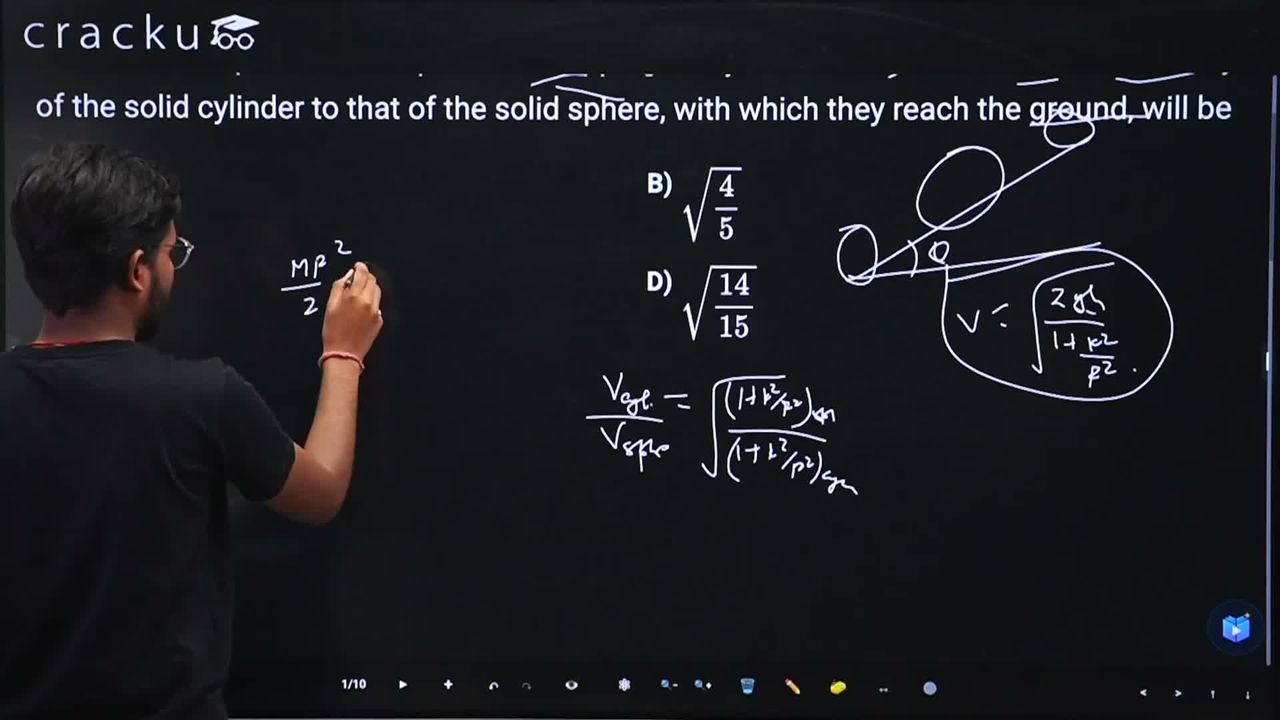
A solid cylinder and a solid sphere, having same mass $$M$$ and radius $$R$$, roll down the same inclined plane from top without slipping. They start from rest. The ratio of velocity of the solid cylinder to that of the solid sphere, with which they reach the ground, will be
We need to find the ratio of the final linear velocity of a rolling solid cylinder to that of a rolling solid sphere when they start from rest and roll down the same inclined plane without slipping.
When an object of mass $$M$$ and radius $$R$$ rolls down an inclined plane of height $$h$$ without slipping, its initial potential energy is converted into both translational and rotational kinetic energy:
$$Mgh = \frac{1}{2}Mv^2 + \frac{1}{2}I\omega^2$$
Since the object rolls without slipping, its angular velocity is $$\omega = \frac{v}{R}$$. Substituting this and writing the moment of inertia in terms of its radius of gyration ($$I = MK^2$$):
$$Mgh = \frac{1}{2}Mv^2 + \frac{1}{2}(MK^2)\left(\frac{v}{R}\right)^2$$
$$Mgh = \frac{1}{2}Mv^2 \left(1 + \frac{K^2}{R^2}\right)$$
Canceling out the mass ($$M$$) and isolating the velocity ($$v$$) gives:
$$v = \sqrt{\frac{2gh}{1 + \frac{K^2}{R^2}}}$$
Since both objects fall from the same height ($$h$$), their velocities are inversely proportional to their rolling factor:
$$v \propto \frac{1}{\sqrt{1 + \frac{K^2}{R^2}}}$$
The moment of inertia is $$I_{\text{cylinder}} = \frac{1}{2}MR^2 \implies \frac{K^2}{R^2} = \frac{1}{2}$$
$$1 + \frac{K^2}{R^2} = 1 + \frac{1}{2} = \frac{3}{2}$$
The moment of inertia is $$I_{\text{sphere}} = \frac{2}{5}MR^2 \implies \frac{K^2}{R^2} = \frac{2}{5}$$
$$1 + \frac{K^2}{R^2} = 1 + \frac{2}{5} = \frac{7}{5}$$
Taking the ratio of their final linear velocities:
$$\frac{v_{\text{cylinder}}}{v_{\text{sphere}}} = \sqrt{\frac{1 + \left(\frac{K^2}{R^2}\right)_{\text{sphere}}}{1 + \left(\frac{K^2}{R^2}\right)_{\text{cylinder}}}}$$
Substitute the calculated values into the ratio expression:
$$\frac{v_{\text{cylinder}}}{v_{\text{sphere}}} = \sqrt{\frac{\frac{7}{5}}{\frac{3}{2}}} = \sqrt{\frac{7}{5} \times \frac{2}{3}} = \sqrt{\frac{14}{15}}$$
The ratio of the velocity of the solid cylinder to that of the solid sphere is $$\sqrt{\frac{14}{15}}$$
Was this solution helpful?
Click on the Email ☝️ to Watch the Video Solution
Create a FREE account and get:
_1.webp)

Educational materials for JEE preparation

Ask our AI anything

AI can make mistakes. Please verify important information.
AI can make mistakes. Please verify important information.
