
Join Our JEE Preparation Group
Prep with like-minded aspirants; Get access to free daily tests and study material.
Sign in
Please select an account to continue using cracku.in
↓ →
Join Our JEE Preparation Group
Prep with like-minded aspirants; Get access to free daily tests and study material.
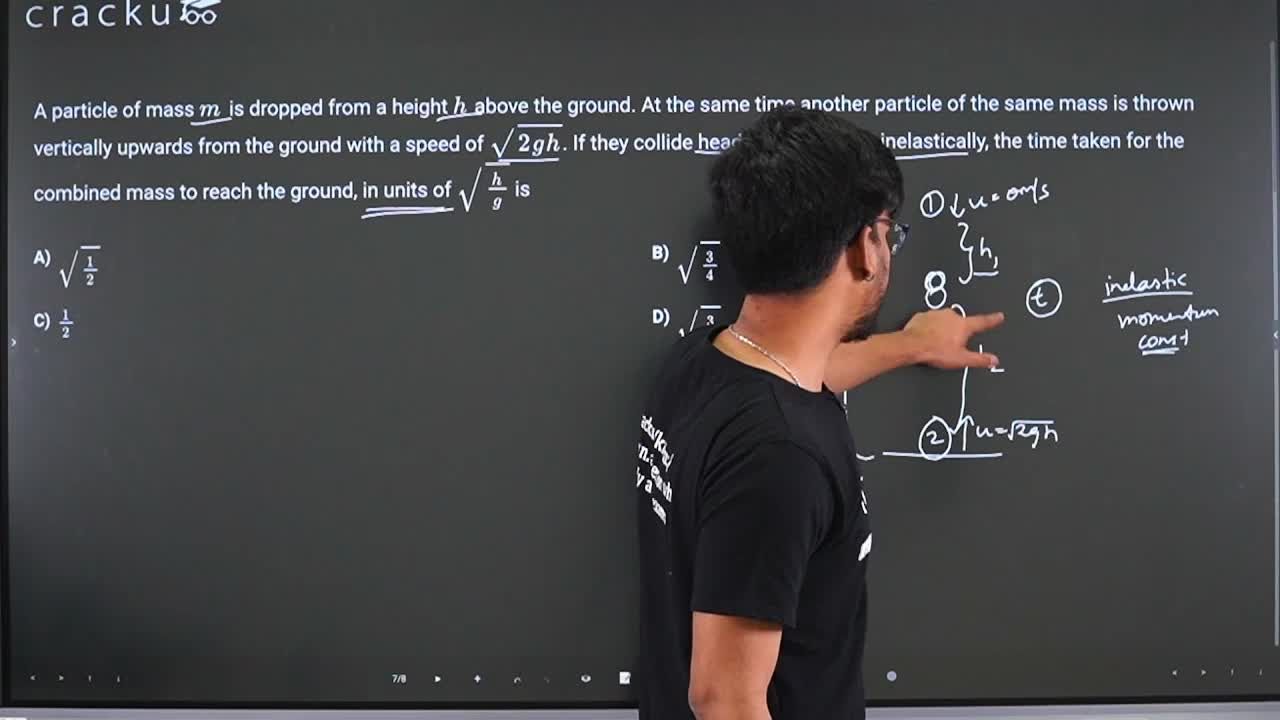
A particle of mass $$m$$ is dropped from a height $$h$$ above the ground. At the same time another particle of the same mass is thrown vertically upwards from the ground with a speed of $$\sqrt{2gh}$$. If they collide head-on completely inelastically, the time taken for the combined mass to reach the ground, in units of $$\sqrt{\frac{h}{g}}$$ is
Relative acceleration and velocity before collision:
$$a_{\text{rel}} = (-g) - (-g) = 0$$
$$v_{\text{rel}} = u_2 - u_1 = \sqrt{2gh} - 0 = \sqrt{2gh}$$
Collision time $$t_1$$: $$t_1 = \frac{h}{v_{\text{rel}}} = \frac{h}{\sqrt{2gh}} = \sqrt{\frac{h}{2g}}$$
Velocities and height at $$t_1$$: $$v_1 = u_1 - gt_1 = -g\sqrt{\frac{h}{2g}} = -\sqrt{\frac{gh}{2}}$$
$$v_2 = u_2 - gt_1 = \sqrt{2gh} - g\sqrt{\frac{h}{2g}} = \sqrt{\frac{gh}{2}}$$
$$y = u_2 t_1 - \frac{1}{2}gt_1^2 = \sqrt{2gh}\sqrt{\frac{h}{2g}} - \frac{1}{2}g\left(\frac{h}{2g}\right) = \frac{3h}{4}$$
Conservation of linear momentum:
$$m v_2 + m v_1 = (2m) v_c \implies m\left(\sqrt{\frac{gh}{2}}\right) + m\left(-\sqrt{\frac{gh}{2}}\right) = 2m v_c \implies v_c = 0$$
Free fall of combined mass from height $$y$$:
$$y = \frac{1}{2}g t_2^2 \implies \frac{3h}{4} = \frac{1}{2}g t_2^2 \implies t_2 = \sqrt{\frac{3h}{2g}} = \sqrt{\frac{3}{2}}\sqrt{\frac{h}{g}}$$
Was this solution helpful?
Click on the Email ☝️ to Watch the Video Solution
Create a FREE account and get:
_1.webp)

Educational materials for JEE preparation

Ask our AI anything

AI can make mistakes. Please verify important information.
AI can make mistakes. Please verify important information.


