
Join Our JEE Preparation Group
Prep with like-minded aspirants; Get access to free daily tests and study material.
Sign in
Please select an account to continue using cracku.in
↓ →
Join Our JEE Preparation Group
Prep with like-minded aspirants; Get access to free daily tests and study material.
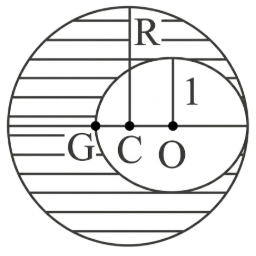
As shown in figure. When a spherical cavity (centred at O) of radius 1 is cut out of a uniform sphere of radius R (centred at C), the centre of mass of remaining (shaded part of sphere is at G, i.e., on the surface of the cavity. R can be determined by the equation:
Let us denote the uniform mass-density of the material by $$\rho$$.
We first write the masses of the two spheres explicitly. For the big sphere (centre at $$C$$, radius $$R$$)
$$M_{\text{big}}=\dfrac{4\pi}{3}\rho R^{3}$$
and for the cavity (centre at $$O$$, radius $$1$$)
$$M_{\text{cav}}=\dfrac{4\pi}{3}\rho \;1^{3}= \dfrac{4\pi}{3}\rho.$$
The mass of the remaining (shaded) solid is therefore
$$M_{\text{rem}}=M_{\text{big}}-M_{\text{cav}}=\dfrac{4\pi}{3}\rho\left(R^{3}-1\right).$$
Because the situation is completely symmetrical about the straight line $$CO$$, the centre of mass of the remainder must lie somewhere on this very line. We choose the origin of the one-dimensional coordinate axis at $$O$$ and measure every distance along $$OC$$ as positive. With this choice
$$x_{O}=0,\qquad x_{C}=d \;(=\;OC).$$
The point $$G$$, by statement of the problem, is situated on the surface of the cavity, that is exactly one unit away from $$O$$ along the same line, so
$$x_{G}=1.$$
Now we invoke the centre-of-mass formula for a composite body:
$$M_{\text{rem}}\;x_{G}=M_{\text{big}}\;x_{C}-M_{\text{cav}}\;x_{O}.$$
Substituting the known quantities, we have
$$\left[\dfrac{4\pi}{3}\rho\left(R^{3}-1\right)\right](1)=\left[\dfrac{4\pi}{3}\rho R^{3}\right]\,d-\left[\dfrac{4\pi}{3}\rho\right](0).$$
All common factors $$\dfrac{4\pi}{3}\rho$$ cancel immediately, leaving the simple relation
$$R^{3}-1=R^{3}\,d\qquad\Longrightarrow\qquad d=\dfrac{R^{3}-1}{R^{3}}=1-\dfrac{1}{R^{3}}.$$
Up to this point, every value of $$R>1$$ would merely give a different permissible separation $$d$$ of the two centres. However, the drawing that accompanies the question shows the cavity touching the outer surface of the large sphere at a single point. For two spheres of radii $$R$$ (big) and $$1$$ (cavity) this “tangential” condition means quite simply
$$OC+1=R\qquad\Longrightarrow\qquad d=R-1.$$
Putting this geometric condition together with the mass-balance condition just obtained we write
$$1-\dfrac{1}{R^{3}}=R-1.$$
Rearranging,
$$2-R-\dfrac{1}{R^{3}}=0\qquad\Longrightarrow\qquad 1=R^{3}(2-R).$$
We still have the factor $$R^{3}$$ on the right. It is convenient to eliminate it by first observing from an earlier step that
$$R^{3}-1=R^{3}(R-1).$$
Dividing both members of this identity by $$R-1$$ (with $$R\neq1$$) we get the well-known algebraic result
$$R^{3}=R^{2}+R+1.$$
Substituting this expression for $$R^{3}$$ in the equation $$1=R^{3}(2-R)$$ leads directly to
$$1=(R^{2}+R+1)(2-R).$$
Exactly the same algebra appears, term for term, in option A, viz.
$$(R^{2}+R+1)(2-R)=1.$$
Hence, the correct answer is Option A.
Was this solution helpful?
Create a FREE account and get:
_1.webp)

Educational materials for JEE preparation

Ask our AI anything

AI can make mistakes. Please verify important information.
AI can make mistakes. Please verify important information.


