
Join Our JEE Preparation Group
Prep with like-minded aspirants; Get access to free daily tests and study material.
Sign in
Please select an account to continue using cracku.in
↓ →
Join Our JEE Preparation Group
Prep with like-minded aspirants; Get access to free daily tests and study material.
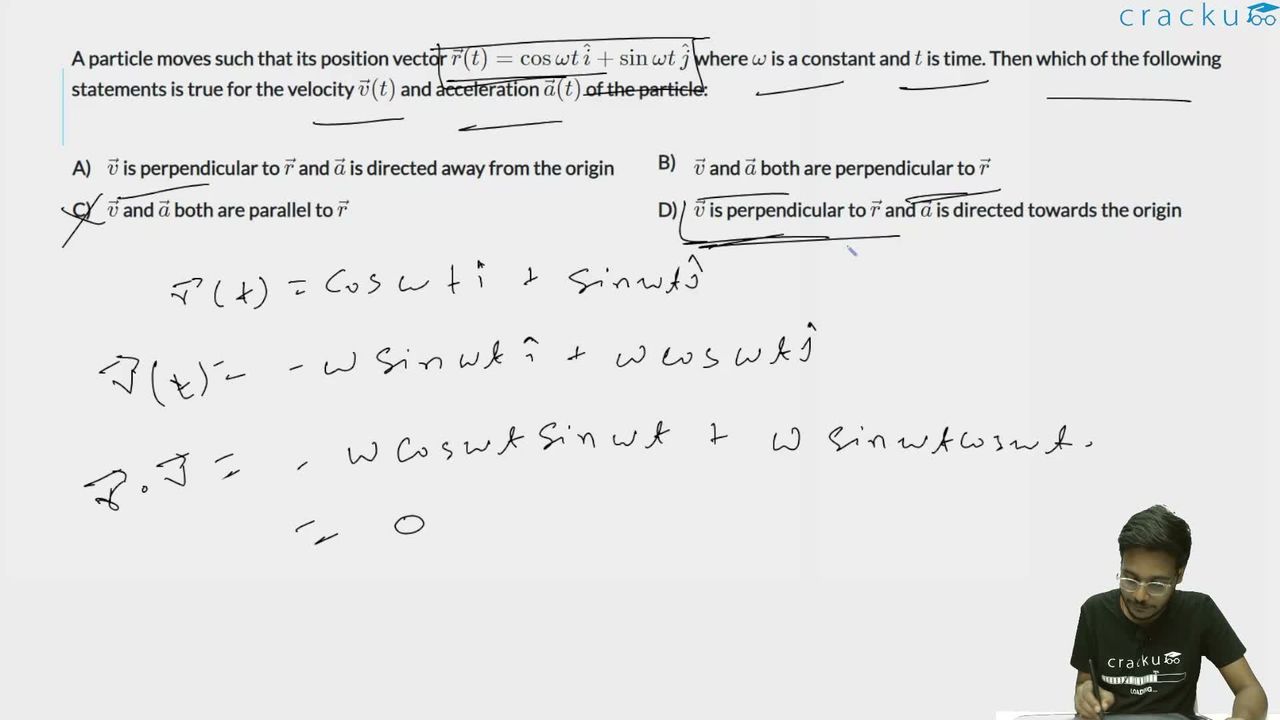
A particle moves such that its position vector $$\vec{r}(t) = \cos\omega t\,\hat{i} + \sin\omega t\,\hat{j}$$ where $$\omega$$ is a constant and $$t$$ is time. Then which of the following statements is true for the velocity $$\vec{v}(t)$$ and acceleration $$\vec{a}(t)$$ of the particle:
We have the position vector of the particle as $$\vec r(t)=\cos\omega t\,\hat i+\sin\omega t\,\hat j,$$ where $$\omega$$ is a constant and $$t$$ is time.
By definition, the velocity vector is the time derivative of the position vector, that is $$\vec v(t)=\dfrac{d\vec r}{dt}.$$
Now, differentiating each component separately and using the standard derivatives $$\dfrac{d}{dt}\bigl(\cos\omega t\bigr)=-\omega\sin\omega t$$ and $$\dfrac{d}{dt}\bigl(\sin\omega t\bigr)=\ \ \omega\cos\omega t,$$ we obtain
$$\vec v(t)=\dfrac{d}{dt}\Bigl(\cos\omega t\,\hat i+\sin\omega t\,\hat j\Bigr)=\bigl(-\omega\sin\omega t\bigr)\hat i+\bigl(\ \ \omega\cos\omega t\bigr)\hat j.$$
Next, we verify whether the velocity is perpendicular to the position vector by taking their dot product. Using the formula $$\vec A\cdot\vec B=A_xB_x+A_yB_y$$ for two‐dimensional vectors, we write
$$\vec r(t)\cdot\vec v(t)=\bigl(\cos\omega t\bigr)\bigl(-\omega\sin\omega t\bigr)+\bigl(\sin\omega t\bigr)\bigl(\ \ \omega\cos\omega t\bigr).$$
Simplifying each term, we have
$$\vec r(t)\cdot\vec v(t)=-\omega\cos\omega t\sin\omega t+\omega\sin\omega t\cos\omega t=0.$$
Because the dot product is zero, $$\vec v(t)\perp\vec r(t).$$ So the velocity is indeed perpendicular to the position vector at every instant.
Now, by definition, the acceleration vector is the time derivative of the velocity vector, that is $$\vec a(t)=\dfrac{d\vec v}{dt}.$$
Differentiating $$\vec v(t)=\bigl(-\omega\sin\omega t\bigr)\hat i+\bigl(\omega\cos\omega t\bigr)\hat j$$ term by term and again using the same trigonometric derivatives, we get
$$\vec a(t)=\dfrac{d}{dt}\Bigl(-\omega\sin\omega t\,\hat i+\omega\cos\omega t\,\hat j\Bigr)=\bigl(-\omega^2\cos\omega t\bigr)\hat i+\bigl(-\omega^2\sin\omega t\bigr)\hat j.$$
Notice that every component of $$\vec a(t)$$ is $$-\omega^2$$ times the corresponding component of $$\vec r(t).$$ Writing this compactly, we have
$$\vec a(t)=-\omega^2\Bigl(\cos\omega t\,\hat i+\sin\omega t\,\hat j\Bigr)=-\omega^2\vec r(t).$$
The negative sign means that $$\vec a(t)$$ is opposite in direction to $$\vec r(t).$$ Since $$\vec r(t)$$ points outward from the origin to the particle, $$-\vec r(t)$$ points inward toward the origin. Hence the acceleration is directed toward the origin, i.e., toward the centre of the circular path.
We have thus shown that the velocity is perpendicular to the position vector and the acceleration is directed toward the origin. Among the given options, this description corresponds to Option D.
Hence, the correct answer is Option D.
Was this solution helpful?
Click on the Email ☝️ to Watch the Video Solution
Create a FREE account and get:
_1.webp)

Educational materials for JEE preparation

Ask our AI anything

AI can make mistakes. Please verify important information.
AI can make mistakes. Please verify important information.


