Join Our JEE Preparation Group
Prep with like-minded aspirants; Get access to free daily tests and study material.
Sign in
Please select an account to continue using cracku.in
↓ →
Join Our JEE Preparation Group
Prep with like-minded aspirants; Get access to free daily tests and study material.
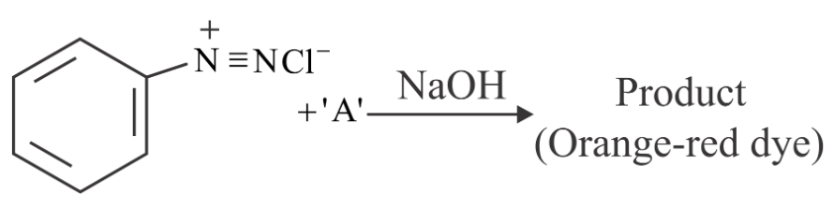
The given reaction is an azo coupling reaction. The benzenediazonium chloride salt acts as a weak electrophile that reacts with highly electron-rich aromatic compounds.
The reaction takes place in a basic medium ($NaOH$). The base is crucial because it deprotonates the hydroxyl group of the incoming reagent to form a highly reactive, strongly nucleophilic anion (like a phenoxide or naphthoxide ion).
To produce a specifically orange-red dye, the required reagent 'A' is $\beta$-naphthol (also known as 2-naphthol). The electrophilic coupling takes place specifically at the 1-position of the naphthol ring, yielding 1-(phenylazo)-2-naphthol. This intense orange-red precipitate is the basis of the classic laboratory azo-dye test for primary aromatic amines.
(For context, coupling this diazonium salt with phenol typically yields a lighter orange dye, while coupling with aniline in an acidic medium yields a yellow dye).
The correctly marked structure in the first box is $\beta$-naphthol.
Correct Reagent 'A': $$\beta$$-naphthol (2-naphthol)
Was this solution helpful?
Create a FREE account and get:
_1.webp)

Educational materials for JEE preparation

Ask our AI anything

AI can make mistakes. Please verify important information.
AI can make mistakes. Please verify important information.