Join Our JEE Preparation Group
Prep with like-minded aspirants; Get access to free daily tests and study material.
Sign in
Please select an account to continue using cracku.in
↓ →
Join Our JEE Preparation Group
Prep with like-minded aspirants; Get access to free daily tests and study material.
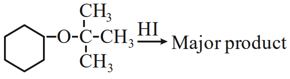
We need to determine the major product formed when the given ether reacts with hydrogen iodide ($$HI$$).
Key Concept: The reaction of an asymmetric ether with a strong acid like $$HI$$ proceeds via protonation of the ether oxygen, followed by a nucleophilic substitution ($$S_N1$$ or $$S_N2$$) reaction by the iodide ion ($$I^-$$).
The given reactant is cyclohexylmethyl t-butyl ether, where an oxygen atom connects a cyclohexylmethyl group and a tertiary butyl ($$t\text{-butyl}$$) group.
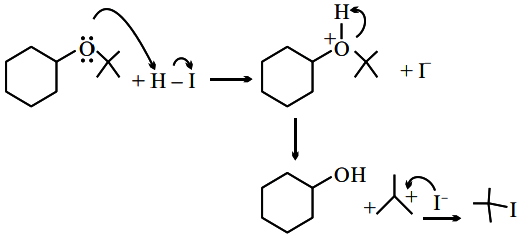
Step 1: Protonation of the ether oxygen
The lone pair of electrons on the ether oxygen attacks the proton of $$HI$$, forming a protonated ether intermediate and releasing an iodide ion ($$I^-$$):
$$\text{R}_1\text{-O-R}_2 + HI \rightarrow \text{R}_1\text{-}\overset{\text{H}}{\overset{+}{\text{O}}}\text{-R}_2 + I^-$$
Step 2: Cleavage of the C-O bond via $$S_N1$$ pathway
Because one of the alkyl groups attached to the oxygen is a tertiary butyl group, the reaction proceeds via an $$S_N1$$ mechanism. The leaving group is cyclohexylmethanol, and a highly stable tertiary butyl carbocation ($$(CH_3)_3C^+$$) is formed stable due to hyperconjugation and inductive effects.
$$\text{Cyclohexylmethyl-}\overset{\text{H}}{\overset{+}{\text{O}}}\text{-C}(CH_3)_3 \rightarrow \text{Cyclohexylmethyl-OH} + ^{+}C(CH_3)_3$$
Step 3: Attack of the nucleophile ($$I^-$$)
The stable tertiary carbocation is then rapidly attacked by the remaining iodide nucleophile ($$I^-$$) to yield tert-butyl iodide:
$$^{-}C(CH_3)_3 + I^- \rightarrow I\text{-C}(CH_3)_3$$
Therefore, the major products formed in this reaction mixture are cyclohexylmethanol and tert-butyl iodide.
Answer: Option D — Cyclohexylmethanol and tert-butyl iodide
Was this solution helpful?
Click on the Email ☝️ to Watch the Video Solution
Create a FREE account and get:
_1.webp)

Educational materials for JEE preparation

Ask our AI anything

AI can make mistakes. Please verify important information.
AI can make mistakes. Please verify important information.