Join Our JEE Preparation Group
Prep with like-minded aspirants; Get access to free daily tests and study material.
Sign in
Please select an account to continue using cracku.in
↓ →
Join Our JEE Preparation Group
Prep with like-minded aspirants; Get access to free daily tests and study material.
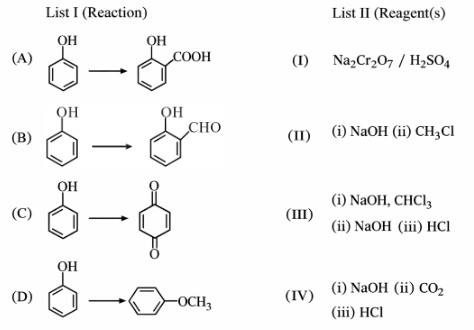
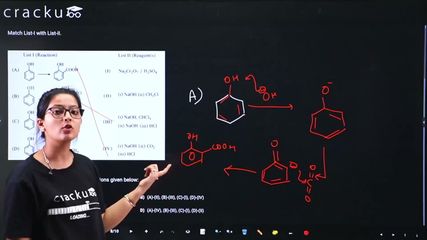
Reaction (A): Conversion of Phenol to Salicylic acid (2-hydroxybenzoic acid). This transformation is achieved via the Kolbe-Schmitt reaction. When phenol is treated with sodium hydroxide ($$NaOH$$) to form a phenoxide ion, followed by reaction with carbon dioxide ($$CO_2$$) under pressure and subsequent acidification with $$HCl$$, salicylic acid is produced. This matches with reagent (IV). Thus, (A) matches with (IV).
Reaction (B): Conversion of Phenol to Salicylaldehyde (2-hydroxybenzaldehyde). This is the Reimer-Tiemann reaction. Phenol reacts with chloroform ($$CHCl_3$$) in the presence of aqueous sodium hydroxide ($$NaOH$$), introducing a formyl group ($$\text{-}CHO$$) at the ortho-position, followed by hydrolysis and acidification ($$HCl$$). This matches with reagent (III). Thus, (B) matches with (III).
Reaction (C): Conversion of Phenol to p-Benzoquinone. Phenol undergoes oxidation when treated with a strong oxidizing agent like acidified sodium dichromate ($$Na_2Cr_2O_7 / H_2SO_4$$) to yield para-benzoquinone. This matches with reagent (I). Thus, (C) matches with (I).
Reaction (D): Conversion of Phenol to Anisole (Methoxybenzene). This is an etherification process (Williamson ether synthesis). Phenol is first converted into sodium phenoxide using $$NaOH$$, which then performs a nucleophilic substitution reaction with methyl chloride ($$CH_3Cl$$) to introduce a methoxy group ($$\text{-}OCH_3$$). This matches with reagent (II). Thus, (D) matches with (II).
Combining all the pairs, the correct matching sequence is: (A)-(IV), (B)-(III), (C)-(I), (D)-(II).
Answer: Option D — (A)-(IV), (B)-(III), (C)-(I), (D)-(II)
Was this solution helpful?
Click on the Email ☝️ to Watch the Video Solution
Create a FREE account and get:
_1.webp)

Educational materials for JEE preparation

Ask our AI anything

AI can make mistakes. Please verify important information.
AI can make mistakes. Please verify important information.