Join Our JEE Preparation Group
Prep with like-minded aspirants; Get access to free daily tests and study material.
Sign in
Please select an account to continue using cracku.in
↓ →
Join Our JEE Preparation Group
Prep with like-minded aspirants; Get access to free daily tests and study material.
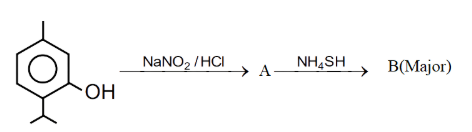
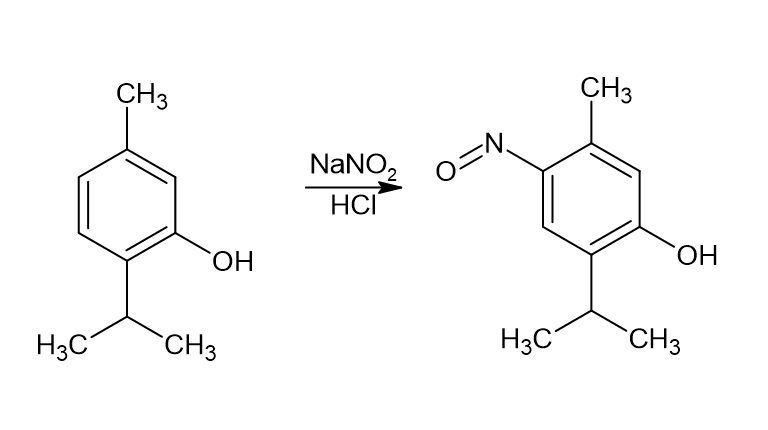
Step 1: Nitrosation ($$\text{NaNO}_2 / \text{HCl}$$)
The starting material is a substituted phenol (thymol derivative). When treated with nitrous acid ($$\text{NaNO}_2 + \text{HCl}4$$ forming $$\text{HNO}_2$$) at a low temperature, it undergoes electrophilic aromatic substitution (nitrosation).
the nitroso electrophile ($$\text{NO}^+$$) attacks at this para-position to form Compound A (a para-nitrosophenol derivative).
Step 2: Selective Reduction ($$\text{NH}_4\text{SH}$$)
Compound A is then treated with ammonium hydrosulfide ($$\text{NH}_4\text{SH}$$).
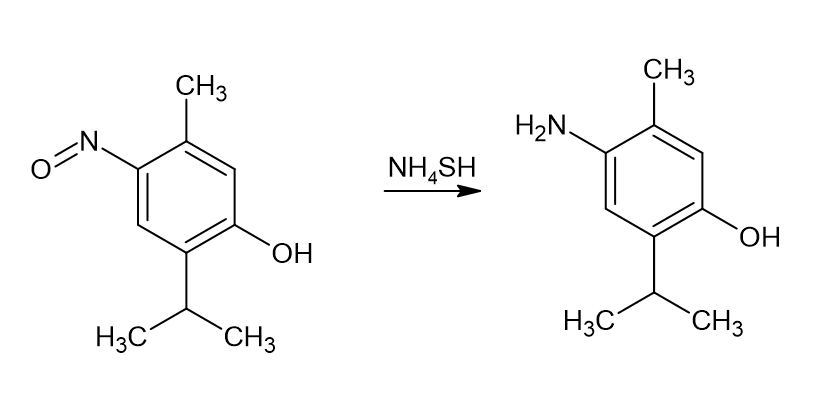
Option A
Was this solution helpful?
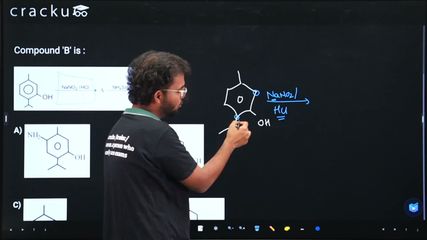
Click on the Email ☝️ to Watch the Video Solution
Create a FREE account and get:
_1.webp)

Educational materials for JEE preparation

Ask our AI anything

AI can make mistakes. Please verify important information.
AI can make mistakes. Please verify important information.