Join Our JEE Preparation Group
Prep with like-minded aspirants; Get access to free daily tests and study material.
Sign in
Please select an account to continue using cracku.in
↓ →
Join Our JEE Preparation Group
Prep with like-minded aspirants; Get access to free daily tests and study material.
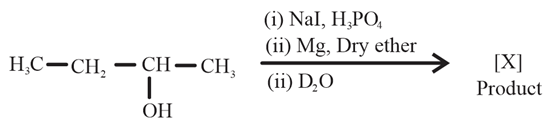
Step 1: Formation of Alkyl Iodide
Sodium iodide ($$\text{NaI}$$) reacts with phosphoric acid ($$\text{H}_3\text{PO}_4$$) to generate hydrogen iodide ($$\text{HI}$$) in situ. The alcohol group ($$-\text{OH}$$) on butan-2-ol is protonated and substituted by the iodide ion ($$\text{I}^-$$) via an $$\text{S}_\text{N}2$$ or $$\text{S}_\text{N}1$$ pathway, converting it into 2-iodobutane.
$$\text{CH}_3-\text{CH}_2-\text{CH(OH)}-\text{CH}_3 \xrightarrow{\text{NaI, H}_3\text{PO}_4} \text{CH}_3-\text{CH}_2-\text{CH(I)}-\text{CH}_3$$
Step 2: Formation of Grignard Reagent
Magnesium metal inserts itself into the carbon-iodine bond in the presence of dry ether, forming a highly reactive Grignard reagent (sec-butylmagnesium iodide).
$$\text{CH}_3-\text{CH}_2-\text{CH(I)}-\text{CH}_3 \xrightarrow{\text{Mg, Dry Ether}} \text{CH}_3-\text{CH}_2-\text{CH(MgI)}-\text{CH}_3$$
Step 3: Deuteration
Grignard reagents are strong bases and react aggressively with any proton/deuterium source. Heavy water ($$\text{D}_2\text{O}$$) supplies a deuterium ion ($$\text{D}^+$$), which replaces the $$-\text{MgI}$$ group.
$$\text{CH}_3-\text{CH}_2-\text{CH(MgI)}-\text{CH}_3 \xrightarrow{\text{D}_2\text{O}} \text{CH}_3-\text{CH}_2-\text{CH(D)}-\text{CH}_3 + \text{Mg(OD)I}$$
The final product is 2-deuterobutane:
$$\mathbf{\text{CH}_3-\text{CH}_2-\text{CH(D)}-\text{CH}_3}$$
Was this solution helpful?
Click on the Email ☝️ to Watch the Video Solution
Create a FREE account and get:
_1.webp)

Educational materials for JEE preparation

Ask our AI anything

AI can make mistakes. Please verify important information.
AI can make mistakes. Please verify important information.