
Join Our JEE Preparation Group
Prep with like-minded aspirants; Get access to free daily tests and study material.
Sign in
Please select an account to continue using cracku.in
↓ →
Join Our JEE Preparation Group
Prep with like-minded aspirants; Get access to free daily tests and study material.
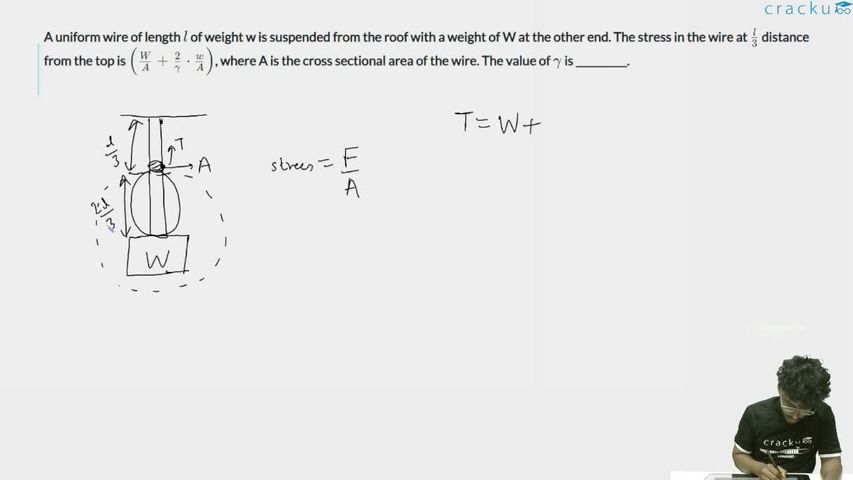
A uniform wire of length $$l$$ of weight w is suspended from the roof with a weight of W at the other end. The stress in the wire at $$\frac{l}{3}$$ distance from the top is $$\left(\frac{W}{A} + \frac{2}{\gamma} \cdot \frac{w}{A}\right)$$, where A is the cross sectional area of the wire. The value of $$\gamma$$ is __________.
Correct Answer: 3
Let the origin be at the top end of the wire and measure distance downward along the wire by the variable $$y$$ (so $$y = 0$$ at the roof and $$y = l$$ at the lower end).
The weight of the entire wire is $$w$$, so its weight per unit length is $$\dfrac{w}{l}\;({\rm N\,m^{-1}})$$.
At a distance $$y$$ from the top, the portion of the wire lying $$\text$$it{below} that point has length $$(l - y)$$. Therefore the weight of that lower portion is
$$\left(l-y\right)\left(\dfrac{w}{l}\right)=w\left(1-\dfrac{y}{l}\right).$$
The tension $$T(y)$$ at the cross-section situated at distance $$y$$ must support both the hanging load $$W$$ and the weight of the wire below that section. Hence
$$T(y)=W+w\left(1-\dfrac{y}{l}\right).$$
The stress $$\sigma(y)$$ equals tension divided by cross-sectional area $$A$$:
$$\sigma(y)=\dfrac{T(y)}{A}=\dfrac{W}{A}+\dfrac{w}{A}\left(1-\dfrac{y}{l}\right).$$
The question asks for the stress at the point where $$y=\dfrac{l}{3}$$, i.e., one-third the length from the top. Substitute $$y=\dfrac{l}{3}$$:
$$\sigma\!\left(\dfrac{l}{3}\right)=\dfrac{W}{A}+\dfrac{w}{A}\left(1-\dfrac{1}{3}\right)=\dfrac{W}{A}+\dfrac{w}{A}\left(\dfrac{2}{3}\right)=\dfrac{W}{A}+\dfrac{2}{3}\dfrac{w}{A}.$$
The given form of the answer is $$\dfrac{W}{A}+\dfrac{2}{\gamma}\dfrac{w}{A}$$. Comparing the two expressions, we equate the coefficients of $$\dfrac{w}{A}$$:
$$\dfrac{2}{\gamma}=\dfrac{2}{3}\; \Longrightarrow\; \gamma=3.$$
Hence, the required value of $$\gamma$$ is 3.
Click on the Email ☝️ to Watch the Video Solution
Create a FREE account and get:
_1.webp)

Educational materials for JEE preparation

Ask our AI anything

AI can make mistakes. Please verify important information.
AI can make mistakes. Please verify important information.


