
Join Our JEE Preparation Group
Prep with like-minded aspirants; Get access to free daily tests and study material.
Sign in
Please select an account to continue using cracku.in
↓ →
Join Our JEE Preparation Group
Prep with like-minded aspirants; Get access to free daily tests and study material.
1 $$\mu$$C charge moving with velocity $$\vec{v} = \left(\hat{i} - 2\hat{j} + 3\hat{k}\right)$$ m/s in the region of magnetic field $$\vec{B} = \left(2\hat{i} + 3\hat{j} - 5\hat{k}\right)$$ T. The magnitude of force acting on it is $$\sqrt{\alpha} \times 10^{-6}$$ N. The value of $$\alpha$$ is __________.
Correct Answer: 171
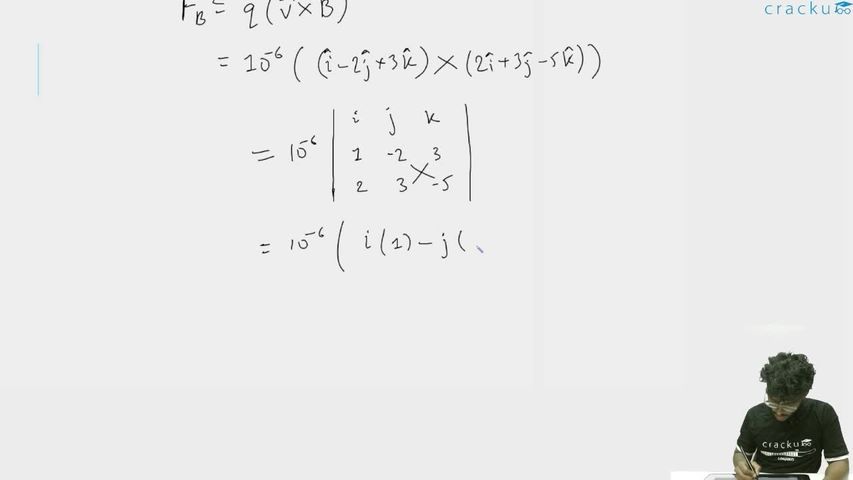
The magnetic (Lorentz) force on a moving point charge is given by
$$\vec{F}=q\,\bigl(\vec{v}\times\vec{B}\bigr)$$
Given data:
Charge, $$q = 1\;\mu\text{C} = 1\times10^{-6}\,\text{C}$$
Velocity, $$\vec{v}=1\,\hat{i}-2\,\hat{j}+3\,\hat{k}\;(\text{m s}^{-1})$$
Magnetic field, $$\vec{B}=2\,\hat{i}+3\,\hat{j}-5\,\hat{k}\;(\text{T})$$
First, calculate the cross product $$\vec{v}\times\vec{B}$$.
Using the determinant form:
$$
\vec{v}\times\vec{B} =
\begin{vmatrix}
\hat{i} & \hat{j} & \hat{k}\\
1 & -2 & 3\\
2 & 3 & -5
\end{vmatrix}
$$
Expand the determinant:
$$
\vec{v}\times\vec{B}
= \hat{i}\bigl((-2)(-5) - (3)(3)\bigr)
- \hat{j}\bigl(1(-5) - 3(2)\bigr)
+ \hat{k}\bigl(1\cdot3 - (-2)\cdot2\bigr)
$$
$$
= \hat{i}\bigl(10 - 9\bigr)
- \hat{j}\bigl(-5 - 6\bigr)
+ \hat{k}\bigl(3 + 4\bigr)
$$
$$
= 1\,\hat{i} + 11\,\hat{j} + 7\,\hat{k}
$$
Magnitude of the cross product:
$$
\lvert\vec{v}\times\vec{B}\rvert
= \sqrt{1^{2}+11^{2}+7^{2}}
= \sqrt{1+121+49}
= \sqrt{171}
$$
Therefore, the magnitude of the magnetic force is
$$
F = q\,\lvert\vec{v}\times\vec{B}\rvert
= \bigl(1\times10^{-6}\bigr)\sqrt{171}\;\text{N}
= \sqrt{171}\times10^{-6}\;\text{N}
$$
Comparing with the required form $$\sqrt{\alpha}\times10^{-6}\,\text{N}$$, we have $$\alpha = 171$$.
Hence, the value of $$\alpha$$ is 171.
Was this solution helpful?
Click on the Email ☝️ to Watch the Video Solution
Create a FREE account and get:
_1.webp)

Educational materials for JEE preparation

Ask our AI anything

AI can make mistakes. Please verify important information.
AI can make mistakes. Please verify important information.
