
Join Our JEE Preparation Group
Prep with like-minded aspirants; Get access to free daily tests and study material.
Sign in
Please select an account to continue using cracku.in
↓ →
Join Our JEE Preparation Group
Prep with like-minded aspirants; Get access to free daily tests and study material.
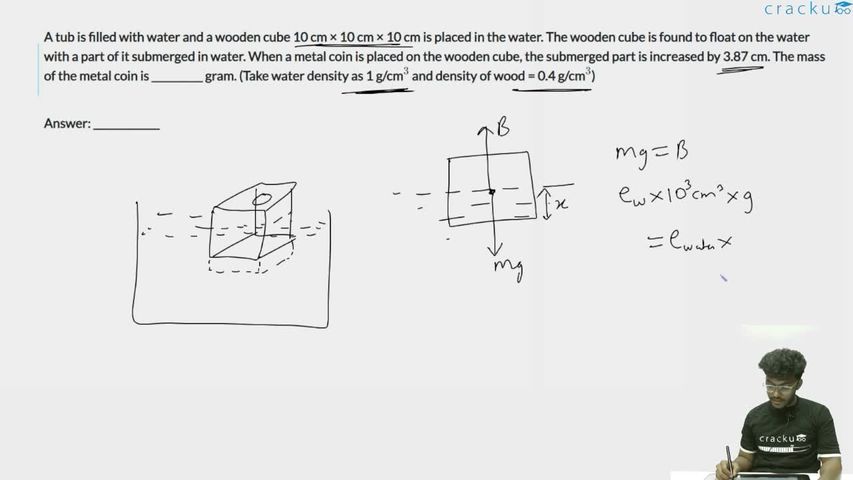
A tub is filled with water and a wooden cube 10 cm × 10 cm × 10 cm is placed in the water. The wooden cube is found to float on the water with a part of it submerged in water. When a metal coin is placed on the wooden cube, the submerged part is increased by 3.87 cm. The mass of the metal coin is __________ gram. (Take water density as 1 g/cm$$^3$$ and density of wood = 0.4 g/cm$$^3$$)
Correct Answer: 387
A wooden cube has side $$l = 10 \text{ cm}$$, hence its volume is
$$V_{\text{cube}} = l^{3} = 10 \times 10 \times 10 = 1000 \text{ cm}^{3}$$.
Given density of wood $$\rho_{\text{wood}} = 0.4 \text{ g/cm}^{3}$$, its mass is
$$m_{\text{cube}} = \rho_{\text{wood}} \, V_{\text{cube}} = 0.4 \times 1000 = 400 \text{ g}$$.
According to Archimedes’ principle, a floating body displaces its own weight of fluid.
Let the initial submerged height be $$h_1$$. The base area of the cube is
$$A = 10 \times 10 = 100 \text{ cm}^2.$$
Volume of water displaced initially is $$V_1 = A h_1$$, and because water has density $$1 \text{ g/cm}^{3}$$, the mass of displaced water equals this volume in grams:
$$A h_1 = m_{\text{cube}} = 400 \text{ g}$$
$$\Rightarrow h_1 = \frac{400}{100} = 4 \text{ cm}.$$
When a metal coin is placed on the cube, the submerged height increases by $$3.87 \text{ cm}$$:
$$h_2 = h_1 + 3.87 = 4 + 3.87 = 7.87 \text{ cm}.$$
New volume of water displaced:
$$V_2 = A h_2 = 100 \times 7.87 = 787 \text{ cm}^3.$$
This displaced water now supports the weight of both the cube and the coin: $$m_{\text{cube}} + m_{\text{coin}} = V_2 \text{ g}.$$
Hence,
$$400 + m_{\text{coin}} = 787$$
$$\Rightarrow m_{\text{coin}} = 787 - 400 = 387 \text{ g}.$$
Therefore, the mass of the metal coin is 387 g.
Click on the Email ☝️ to Watch the Video Solution
Create a FREE account and get:
_1.webp)

Educational materials for JEE preparation

Ask our AI anything

AI can make mistakes. Please verify important information.
AI can make mistakes. Please verify important information.


