
Join Our JEE Preparation Group
Prep with like-minded aspirants; Get access to free daily tests and study material.
Sign in
Please select an account to continue using cracku.in
↓ →
Join Our JEE Preparation Group
Prep with like-minded aspirants; Get access to free daily tests and study material.
Match List I with List II
| List-I (Polymer) | List-II (Nature) |
|---|---|
A
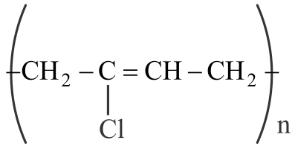 | I. Thermosetting polymer |
B
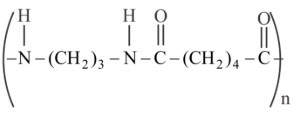 | II. Fibers |
C
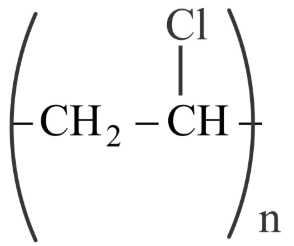 | III. Elastomer |
D
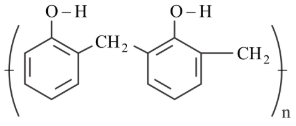 | IV. Thermoplastic polymer |
Polymer $$\mathrm{A}$$ represents:
$$\mathrm{Neoprene}$$
Neoprene is a synthetic rubber.
Rubbers possess weak intermolecular forces, allowing polymer chains to stretch easily.
Hence, neoprene is an:
$$\mathrm{Elastomer}$$
Thus:
$$\mathrm{A \rightarrow III}$$
Polymer $$\mathrm{B}$$ represents:
$$\mathrm{Nylon\ 6,6}$$
Nylon contains strong intermolecular hydrogen bonding between polymer chains.
This gives high tensile strength and close packing of chains.
Hence, nylon behaves as a:
$$\mathrm{Fiber}$$
Thus:
$$\mathrm{B \rightarrow II}$$
Polymer $$\mathrm{C}$$ represents:
$$\mathrm{Polyvinyl\ Chloride\ (PVC)}$$
PVC softens on heating and hardens on cooling without undergoing chemical change.
This is the characteristic property of:
$$\mathrm{Thermoplastic\ Polymers}$$
Thus:
$$\mathrm{C \rightarrow IV}$$
Polymer $$\mathrm{D}$$ represents:
$$\mathrm{Phenol\text{-}Formaldehyde\ Resin}$$
On heating, extensive cross-linking occurs, producing a rigid three-dimensional network.
Once formed, it cannot be remelted or reshaped.
Hence, it is a:
$$\mathrm{Thermosetting\ Polymer}$$
Thus:
$$\mathrm{D \rightarrow I}$$
Therefore, the correct matching is:
$$\mathrm{A\text{-}III,\ B\text{-}II,\ C\text{-}IV,\ D\text{-}I}$$
Was this solution helpful?
Create a FREE account and get:
_1.webp)

Educational materials for JEE preparation

Ask our AI anything

AI can make mistakes. Please verify important information.
AI can make mistakes. Please verify important information.
