
Join Our JEE Preparation Group
Prep with like-minded aspirants; Get access to free daily tests and study material.
Sign in
Please select an account to continue using cracku.in
↓ →
Join Our JEE Preparation Group
Prep with like-minded aspirants; Get access to free daily tests and study material.
The reaction $$2X \to B$$ is a zeroth order reaction. If the initial concentration of X is 0.2M, the half-life is 6 h. When the initial concentration of X is 0.5M, the time required to reach its final concentration of 0.2M will be
We are told that the reaction $$2X \to B$$ follows zeroth-order kinetics. For any zeroth-order reaction the rate law is stated first:
$$\text{Rate}=k\;,$$
where $$k$$ is the zeroth-order rate constant having the units $$\text{mol L}^{-1}\text{h}^{-1}$$ (or $$\text{M h}^{-1}$$).
The integrated form of the zeroth-order rate law, obtained by integrating $$d[X]/dt=-k$$, is
$$[X]=[X]_0-k\,t$$
where $$[X]_0$$ is the initial concentration and $$[X]$$ is the concentration after time $$t$$.
We also need the relationship between the half-life and the rate constant for a zeroth-order reaction. The half-life $$t_{1/2}$$ is defined as the time when $$[X]$$ becomes $$[X]_0/2$$. Substituting $$[X]=[X]_0/2$$ and $$t=t_{1/2}$$ into the integrated law:
$$\frac{[X]_0}{2}=[X]_0-k\,t_{1/2}$$
Simplifying, we obtain the well-known zeroth-order half-life formula:
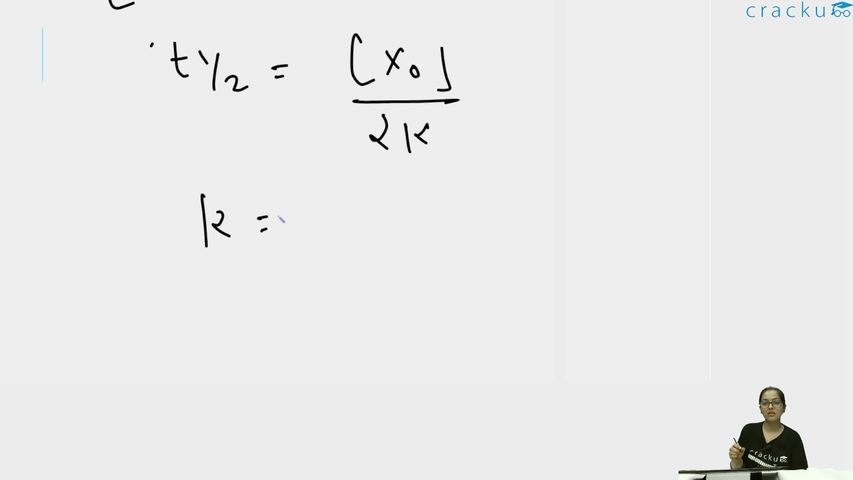
$$t_{1/2}=\frac{[X]_0}{2k}$$
Now we use the data from the first experiment, where $$[X]_0=0.2\ \text{M}$$ and $$t_{1/2}=6\ \text{h}$$, to determine $$k$$. Rearranging the formula just written gives
$$k=\frac{[X]_0}{2\,t_{1/2}}$$
Substituting the numerical values:
$$k=\frac{0.2\ \text{M}}{2 \times 6\ \text{h}}=\frac{0.2}{12}\ \text{M h}^{-1}=0.016666\ldots\ \text{M h}^{-1}$$
So, $$k=0.0167\ \text{M h}^{-1}$$ when rounded to four significant figures.
Next we analyse the second situation, where the initial concentration is $$[X]_0=0.5\ \text{M}$$ and we wish to know the time $$t$$ taken for the concentration to fall to $$[X]=0.2\ \text{M}$$. We again start from the integrated rate law
$$[X]=[X]_0-k\,t$$
and solve for $$t$$:
$$t=\frac{[X]_0-[X]}{k}$$
Substituting the known quantities:
$$t=\frac{0.5\ \text{M}-0.2\ \text{M}}{0.016666\ldots\ \text{M h}^{-1}} =\frac{0.3\ \text{M}}{0.016666\ldots\ \text{M h}^{-1}}$$
Carrying out the division gives
$$t=18\ \text{h}$$
Therefore, the time required for the concentration of $$X$$ to decrease from $$0.5\ \text{M}$$ to $$0.2\ \text{M}$$ is 18 hours.
Hence, the correct answer is Option C.
Was this solution helpful?
Click on the Email ☝️ to Watch the Video Solution
Create a FREE account and get:
_1.webp)

Educational materials for JEE preparation

Ask our AI anything

AI can make mistakes. Please verify important information.
AI can make mistakes. Please verify important information.


