
Join Our JEE Preparation Group
Prep with like-minded aspirants; Get access to free daily tests and study material.
Sign in
Please select an account to continue using cracku.in
↓ →
Join Our JEE Preparation Group
Prep with like-minded aspirants; Get access to free daily tests and study material.
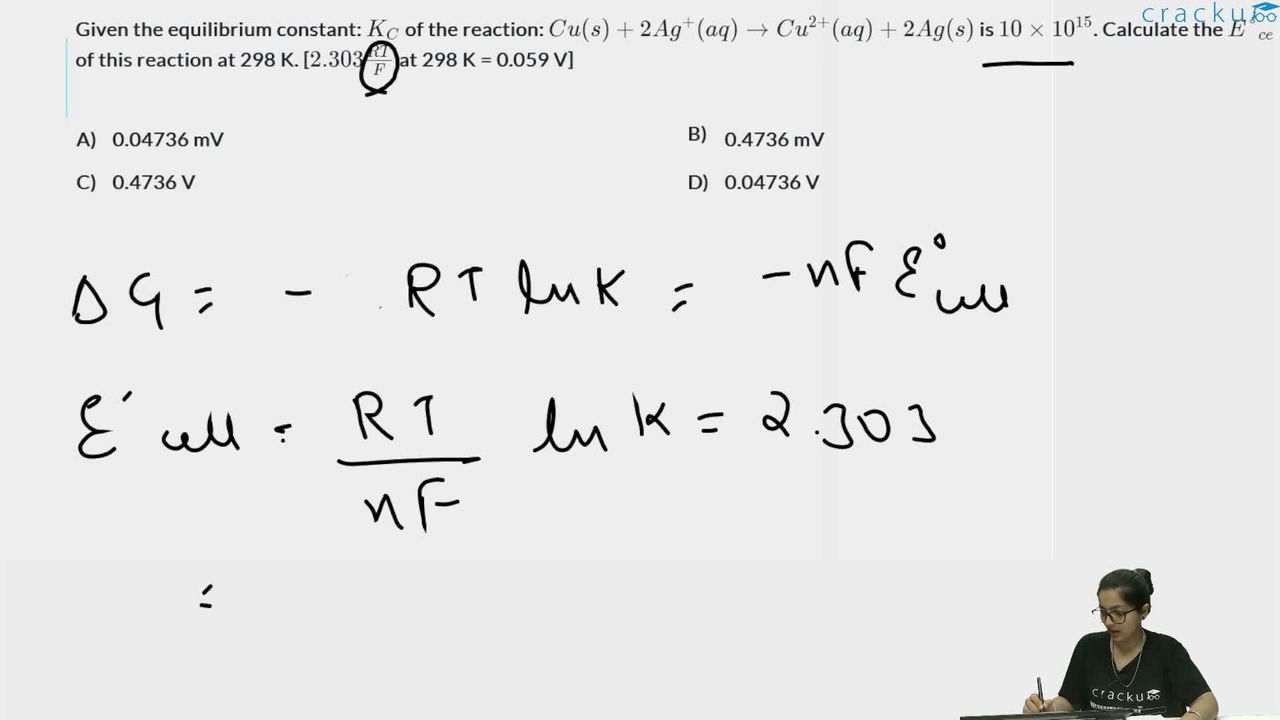
Given the equilibrium constant: $$K_C$$ of the reaction: $$Cu(s) + 2Ag^+(aq) \to Cu^{2+}(aq) + 2Ag(s)$$ is $$10 \times 10^{15}$$. Calculate the $$E°_{cell}$$ of this reaction at 298 K. [$$2.303 \frac{RT}{F}$$ at 298 K = 0.059 V]
First we recall the thermodynamic relation that links the standard cell potential $$E^{\circ}_{cell}$$ with the equilibrium constant $$K_C$$.
The Gibbs energy change at standard state is written as
$$\Delta G^{\circ}= -\,RT\ln K_C.$$
For an electrochemical cell we also have
$$\Delta G^{\circ}= -\,nF\,E^{\circ}_{cell},$$
where $$n$$ is the total number of electrons transferred and $$F$$ is the Faraday constant.
Equating the two expressions gives
$$-\,nF\,E^{\circ}_{cell}= -\,RT\ln K_C.$$
Removing the negative signs and solving for $$E^{\circ}_{cell}$$ we get
$$E^{\circ}_{cell}= \frac{RT}{nF}\,\ln K_C.$$
To convert the natural logarithm to the common (base-10) logarithm, we use $$\ln K_C = 2.303 \log_{10} K_C$$; hence
$$E^{\circ}_{cell}= \frac{2.303\,RT}{nF}\,\log_{10} K_C.$$
The problem already provides the factor
$$\frac{2.303\,RT}{F}=0.059\;{\rm V}\quad{\rm at}\;298\;{\rm K},$$
so the expression simplifies to
$$E^{\circ}_{cell}= \frac{0.059\;{\rm V}}{n}\,\log_{10} K_C.$$
Now we analyse the given redox reaction
$$Cu(s)+2Ag^{+}(aq)\;\longrightarrow\;Cu^{2+}(aq)+2Ag(s).$$
Each copper atom loses two electrons when it is oxidised from $$Cu$$ to $$Cu^{2+}$$, while each silver ion gains one electron when it is reduced from $$Ag^{+}$$ to $$Ag$$. Because two silver ions participate, the total number of electrons exchanged is
$$n = 2.$$
The equilibrium constant is given as
$$K_C = 10 \times 10^{15}=1.0 \times 10^{16}.$$
We next determine its decimal logarithm:
$$\log_{10} K_C=\log_{10}(1.0\times10^{16})=16.$$
Substituting all the values into the simplified Nernst-type expression, we obtain
$$ E^{\circ}_{cell}= \frac{0.059\;{\rm V}}{2}\times 16. $$
Carrying out the division first,
$$\frac{0.059}{2}=0.0295\;{\rm V},$$
and then the multiplication,
$$0.0295\;{\rm V}\times16 =0.472\;{\rm V}.$$
Using the more precise value $$0.0592\;{\rm V}$$ for $$2.303RT/F$$ (often rounded in data tables) gives
$$\frac{0.0592}{2}\times16 =0.0296\times16 =0.4736\;{\rm V}.$$
Thus, to the significant figures implied by the options,
$$E^{\circ}_{cell}\approx 0.474\;{\rm V}.$$
Among the choices offered, the value that matches is $$0.4736\;{\rm V}.$$
Hence, the correct answer is Option C.
Was this solution helpful?
Click on the Email ☝️ to Watch the Video Solution
Create a FREE account and get:
_1.webp)

Educational materials for JEE preparation

Ask our AI anything

AI can make mistakes. Please verify important information.
AI can make mistakes. Please verify important information.


