
Join Our JEE Preparation Group
Prep with like-minded aspirants; Get access to free daily tests and study material.
Sign in
Please select an account to continue using cracku.in
↓ →
Join Our JEE Preparation Group
Prep with like-minded aspirants; Get access to free daily tests and study material.
For the cell $$Zn(s) | Zn^{2+}(aq) || M^{x+}(aq) | M(s)$$, different half cells and their standard electrode potentials are given below:
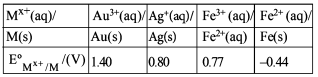
If $$E°_{Zn^{2+}/Zn} = -0.76$$ V, which cathode will give a maximum value of $$E°_{cell}$$ per electron transferred?
The galvanic cell is written as
$$Zn(s)\;|\;Zn^{2+}(aq)\;||\;M^{x+}(aq)\;|\;M(s)$$
In such a cell the left-hand electrode (zinc) behaves as the anode and the right-hand electrode behaves as the cathode.
Standard cell potential is calculated with the reduction potentials of the two half-cells:
$$E^\circ_{\text{cell}} = E^\circ_{\text{cathode}} - E^\circ_{\text{anode}} \qquad -(1)$$
The reduction potential of the zinc half-cell is given as
$$E^\circ_{Zn^{2+}/Zn} = -0.76\;{\text V}$$
Because zinc actually undergoes oxidation in the working cell, the sign is not changed inside the formula (1); we always insert the tabulated reduction potentials.
Hence,
$$E^\circ_{\text{cell}} = E^\circ_{\text{cathode}} - (-0.76) = E^\circ_{\text{cathode}} + 0.76\;{\text V} \qquad -(2)$$
Equation (2) shows that the larger the standard reduction potential of the cathode, the larger the standard emf of the overall cell (the term $$+0.76$$ is a constant for every choice of cathode).
The given cathode couples and their standard reduction potentials are:
$$Ag^+/Ag : +0.80\;{\text V}$$
$$Fe^{3+}/Fe^{2+} : +0.77\;{\text V}$$
$$Au^{3+}/Au : +1.50\;{\text V}$$
$$Fe^{2+}/Fe : -0.44\;{\text V}$$
The largest value is $$+1.50\;{\text V}$$ for the $$Au^{3+}/Au$$ couple.
Therefore, choosing $$Au^{3+}/Au$$ as the cathode gives the maximum possible $$E^\circ_{\text{cell}}$$ (per electron or otherwise) for the given zinc anode.
Option C which is: $$Au^{3+}/Au$$
Was this solution helpful?
Create a FREE account and get:
_1.webp)

Educational materials for JEE preparation

Ask our AI anything

AI can make mistakes. Please verify important information.
AI can make mistakes. Please verify important information.
