
Join Our JEE Preparation Group
Prep with like-minded aspirants; Get access to free daily tests and study material.
Sign in
Please select an account to continue using cracku.in
↓ →
Join Our JEE Preparation Group
Prep with like-minded aspirants; Get access to free daily tests and study material.
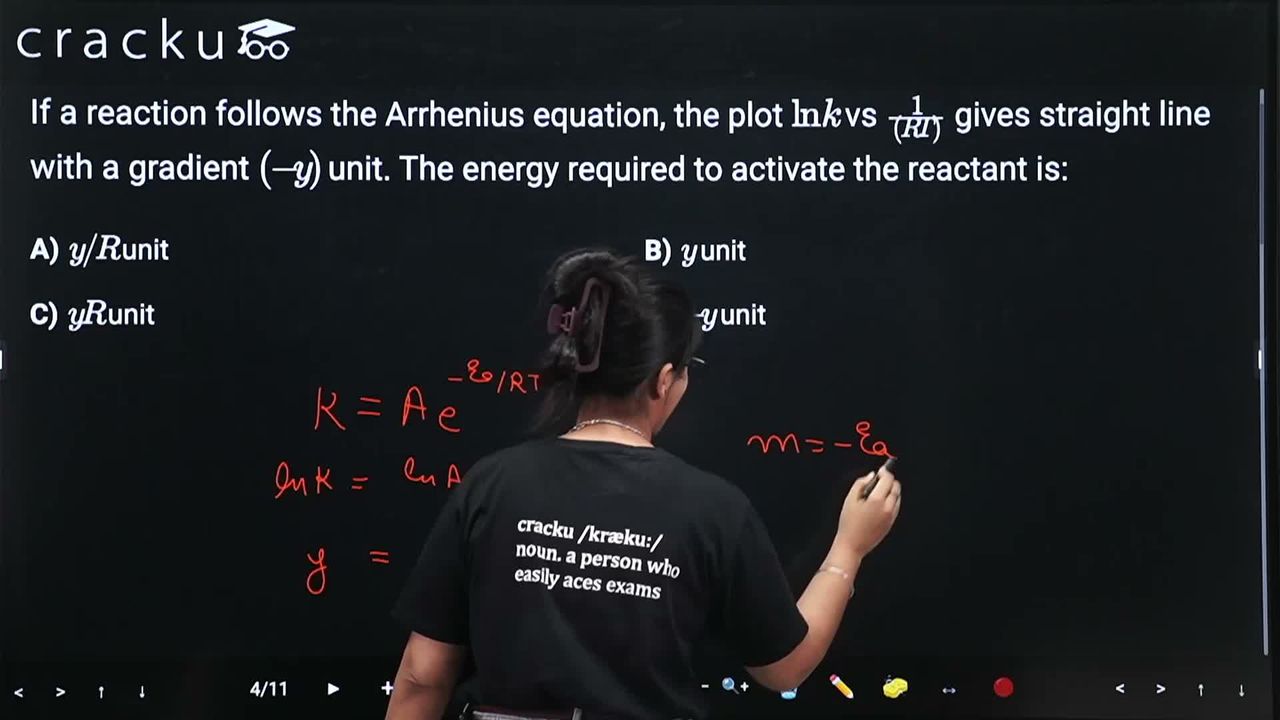
If a reaction follows the Arrhenius equation, the plot $$\ln k$$ vs $$\frac{1}{(RT)}$$ gives straight line with a gradient $$(-y)$$ unit. The energy required to activate the reactant is:
We begin with the Arrhenius equation for the temperature-dependence of the rate constant:
$$k=A\,e^{-E_a/(RT)}$$
Taking natural logarithms on both sides, we use the property $$\ln(e^x)=x$$ to obtain
$$\ln k=\ln A-\dfrac{E_a}{RT}.$$
The question says that a graph of $$\ln k$$ (vertical axis) is drawn against $$\dfrac{1}{RT}$$ (horizontal axis). So, let us write the above equation explicitly in the straight-line form $$y=mx+c$$ with
$$y=\ln k,\qquad x=\dfrac{1}{RT}.$$
Substituting the chosen $$x$$ into the Arrhenius expression, we have
$$\ln k=\ln A-E_a\left(\dfrac{1}{RT}\right).$$
Comparing this with $$y=mx+c$$ we identify
$$m=-E_a,$$
because the coefficient of $$x$$ (which is $$1/(RT)$$) is $$-E_a$$, while the intercept $$c$$ is $$\ln A$$.
According to the statement of the problem, the experimentally obtained straight line has a gradient (slope) equal to $$-y$$ unit. Thus,
$$m=-y.$$
But we have already shown that $$m=-E_a$$, so equating the two expressions for the slope gives
$$-E_a=-y\quad\Longrightarrow\quad E_a=y.$$
Therefore, the energy required to activate the reactant, $$E_a,$$ is simply $$y$$ in magnitude and carries the same unit mentioned for the gradient.
Hence, the correct answer is Option B.
Was this solution helpful?
Click on the Email ☝️ to Watch the Video Solution
Create a FREE account and get:
_1.webp)

Educational materials for JEE preparation

Ask our AI anything

AI can make mistakes. Please verify important information.
AI can make mistakes. Please verify important information.
