
Join Our JEE Preparation Group
Prep with like-minded aspirants; Get access to free daily tests and study material.
Sign in
Please select an account to continue using cracku.in
↓ →
Join Our JEE Preparation Group
Prep with like-minded aspirants; Get access to free daily tests and study material.
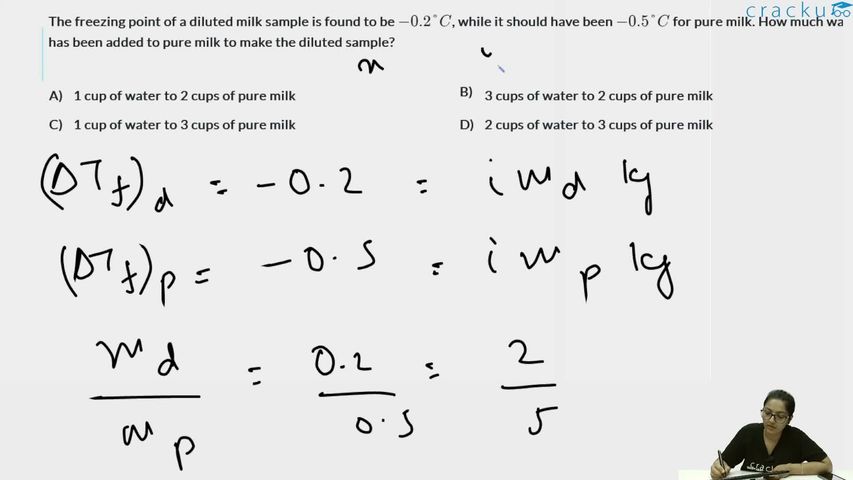
The freezing point of a diluted milk sample is found to be $$-0.2°C$$, while it should have been $$-0.5°C$$ for pure milk. How much water has been added to pure milk to make the diluted sample?
We begin with the well-known relation for freezing-point depression,
$$\Delta T_f = iK_f m,$$
where $$\Delta T_f$$ is the lowering in freezing point, $$i$$ is the van’t Hoff factor, $$K_f$$ is the cryoscopic constant, and $$m$$ is the molality of the solute present. For a given solvent (water in this case) and a fixed solute (the dissolved milk solids), the factors $$i$$ and $$K_f$$ remain the same. Hence, for two samples prepared from the same original milk, the ratio of their freezing-point lowerings equals the ratio of the concentrations of milk solids in the two samples.
Pure milk shows a freezing point of
$$T_{\text{pure}} = 0 \,^ \circ\! \text{C} - 0.5 \,^ \circ\! \text{C} = -0.5 \,^ \circ\! \text{C},$$
so its depression is
$$\Delta T_{f,\text{pure}} = 0.5 \,^\circ\! \text{C}.$$
The diluted sample freezes at
$$T_{\text{diluted}} = 0 \,^\circ\! \text{C} - 0.2 \,^\circ\! \text{C} = -0.2 \,^\circ\! \text{C},$$
so its depression is
$$\Delta T_{f,\text{diluted}} = 0.2 \,^\circ\! \text{C}.$$
Using the proportionality of depression to concentration, we write
$$\frac{\Delta T_{f,\text{diluted}}}{\Delta T_{f,\text{pure}}} \;=\; \frac{m_{\text{diluted}}}{m_{\text{pure}}} \;=\; \frac{C_{\text{diluted}}}{C_{\text{pure}}},$$
where $$C$$ denotes the concentration of milk solids (proportional to the volume of pure milk present per unit total volume).
Substituting the numerical values,
$$\frac{0.2}{0.5} = \frac{C_{\text{diluted}}}{C_{\text{pure}}} \quad\Longrightarrow\quad \frac{C_{\text{diluted}}}{C_{\text{pure}}} = 0.4.$$
Thus the diluted milk contains only 40 % of the concentration of milk solids that pure milk does.
Let us suppose we started with $$x$$ cups of pure milk and then added $$y$$ cups of water. The amount of milk solids remains proportional to $$x$$, while the total volume becomes $$x + y$$. Therefore, the concentration of milk solids in the mixture is
$$C_{\text{diluted}} = \frac{x}{x + y}.$$
Because the concentration of pure milk itself is, by definition, 1 (or 100 %), we have
$$\frac{x}{x + y} = 0.4.$$
Now we solve this equation step by step:
$$x = 0.4(x + y)$$
$$x = 0.4x + 0.4y$$
$$x - 0.4x = 0.4y$$
$$0.6x = 0.4y$$
$$y = \frac{0.6}{0.4}x$$
$$y = 1.5x.$$
This tells us that the volume of water added is 1.5 times the volume of the original milk. Converting 1.5 : 1 into whole-number cups, we multiply by 2 to avoid fractions:
$$\text{Water} : \text{Milk} \;=\; 1.5 : 1 \;=\; \frac{3}{2} : 1 \;=\; 3 : 2.$$
So, 3 cups of water have been mixed with 2 cups of pure milk.
Hence, the correct answer is Option B.
Was this solution helpful?
Click on the Email ☝️ to Watch the Video Solution
Create a FREE account and get:
_1.webp)

Educational materials for JEE preparation

Ask our AI anything

AI can make mistakes. Please verify important information.
AI can make mistakes. Please verify important information.
