
Join Our JEE Preparation Group
Prep with like-minded aspirants; Get access to free daily tests and study material.
Sign in
Please select an account to continue using cracku.in
↓ →
Join Our JEE Preparation Group
Prep with like-minded aspirants; Get access to free daily tests and study material.
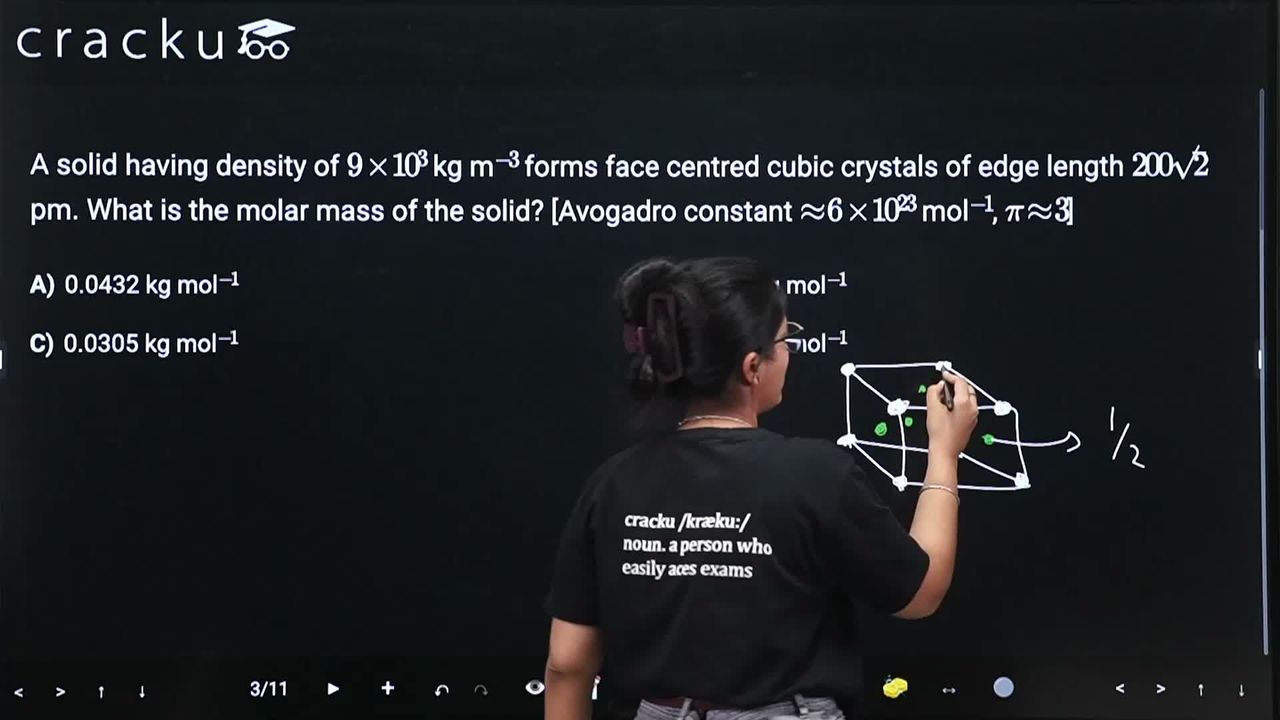
A solid having density of $$9 \times 10^3$$ kg m$$^{-3}$$ forms face centred cubic crystals of edge length $$200\sqrt{2}$$ pm. What is the molar mass of the solid? [Avogadro constant $$\approx 6 \times 10^{23}$$ mol$$^{-1}$$, $$\pi \approx 3$$]
We have a solid of density $$\rho = 9 \times 10^{3}\ \text{kg m}^{-3}$$ which crystallises in a face-centred cubic (fcc) lattice.
For any cubic lattice the general relation between density, molar mass and edge length is stated first:
$$\rho \;=\; \frac{Z\,M}{a^{3}\,N_{A}}$$
where
$$Z = \text{number of atoms per unit cell},$$
$$M = \text{molar mass (kg mol}^{-1}\text{)},$$
$$a = \text{edge length of the unit cell (m)},$$
$$N_{A} = \text{Avogadro constant (mol}^{-1}\text{)}.$$
In an fcc structure, every unit cell contains
$$Z = 4\ \text{atoms}.$$
The edge length is given as $$200\sqrt{2}\ \text{pm}$$. We first convert this completely into metres because the density is in kg m$$^{-3}$$.
1 picometre $$= 10^{-12}\ \text{m}$$, so
$$a = 200\sqrt{2}\ \text{pm} = 200\sqrt{2}\times 10^{-12}\ \text{m}.$$
Putting $$\sqrt{2}\approx1.414$$ we obtain
$$a = 200 \times 1.414 \times 10^{-12}\ \text{m} = 282.8 \times 10^{-12}\ \text{m}.$$
This may be written more compactly as
$$a = 2.828 \times 10^{-10}\ \text{m}.$$
Now we calculate the volume of one unit cell. Because the cell is cubic,
$$a^{3} = (2.828 \times 10^{-10}\ \text{m})^{3}.$$
Carrying out the cube step by step,
$$2.828^{2} = 8.000$$ (because $$2.828 = 2\sqrt{2}$$ and $$(2\sqrt{2})^{2}=8$$), and then
$$2.828^{3} = 8.000 \times 2.828 = 22.624.$$
The power of ten is cubed separately:
$$(10^{-10})^{3}=10^{-30}.$$
Therefore
$$a^{3} = 22.624 \times 10^{-30}\ \text{m}^{3}.$$
To keep only one non-zero digit before the decimal, we rewrite it as
$$a^{3} = 2.2624 \times 10^{-29}\ \text{m}^{3}.$$
Next we determine the mass contained in one unit cell using density:
$$\text{mass of one cell} = \rho \, a^{3} = (9 \times 10^{3})(2.2624 \times 10^{-29})\ \text{kg}.$$
Multiplying the numerical parts,
$$9 \times 2.2624 = 20.3616,$$
and combining the powers of ten,
$$10^{3}\times10^{-29}=10^{-26}.$$
Hence
$$\text{mass of one cell} = 20.3616 \times 10^{-26}\ \text{kg}.$$
Again moving the decimal once to the left,
$$\text{mass of one cell} = 2.03616 \times 10^{-25}\ \text{kg}.$$
Now we insert this mass into the density relation rearranged to give molar mass. From the original formula,
$$M = \frac{\rho\,a^{3}\,N_{A}}{Z}.$$
Substituting each symbol with its value,
$$M = \frac{(2.03616 \times 10^{-25}\ \text{kg}) \; (6 \times 10^{23}\ \text{mol}^{-1})}{4}.$$
First multiply the mass of the unit cell by Avogadro’s number:
$$2.03616 \times 10^{-25} \times 6 \times 10^{23} = 12.21696 \times 10^{-2}\ \text{kg}.$$
Since $$10^{-2}=0.01$$, this is
$$12.21696 \times 0.01\ \text{kg} = 0.1221696\ \text{kg}.$$
Now divide by $$Z = 4$$:
$$M = \frac{0.1221696\ \text{kg}}{4} = 0.0305424\ \text{kg mol}^{-1}.$$
Rounding to three significant figures,
$$M \approx 0.0305\ \text{kg mol}^{-1}.$$
Looking at the given options, this value corresponds to Option C.
Hence, the correct answer is Option C.
Was this solution helpful?
Click on the Email ☝️ to Watch the Video Solution
Create a FREE account and get:
_1.webp)

Educational materials for JEE preparation

Ask our AI anything

AI can make mistakes. Please verify important information.
AI can make mistakes. Please verify important information.
