
Join Our JEE Preparation Group
Prep with like-minded aspirants; Get access to free daily tests and study material.
Sign in
Please select an account to continue using cracku.in
↓ →
Join Our JEE Preparation Group
Prep with like-minded aspirants; Get access to free daily tests and study material.
$$\Lambda_m^°$$ for NaCl, HCl and NaA are 126.4, 425.9 and 100.5 S cm$$^2$$ mol$$^{-1}$$ respectively. If the conductivity of 0.001 M HA is $$5 \times 10^{-5}$$ S cm$$^{-1}$$, degree of dissociation of HA is
We are given the molar conductivities at infinite dilution:
$$\Lambda_m^{\circ}(\text{NaCl}) = 126.4\ \text{S cm}^2\text{ mol}^{-1}$$ $$\Lambda_m^{\circ}(\text{HCl}) = 425.9\ \text{S cm}^2\text{ mol}^{-1}$$ $$\Lambda_m^{\circ}(\text{NaA}) = 100.5\ \text{S cm}^2\text{ mol}^{-1}$$
According to Kohlrausch’s law of independent ionic migration, the molar conductivity at infinite dilution is the sum of the ionic conductivities of its constituent ions:
$$\Lambda_m^{\circ}(AB) = \lambda^{\circ}(A^+) + \lambda^{\circ}(B^-)$$
Let us denote
$$\lambda^{\circ}(\text{Na}^+) = x,\quad \lambda^{\circ}(\text{Cl}^-) = y,\quad \lambda^{\circ}(\text{H}^+) = z,\quad \lambda^{\circ}(\text{A}^-) = w$$
For the three given electrolytes we write the following equations:
1. $$x + y = 126.4$$
2. $$z + y = 425.9$$
3. $$x + w = 100.5$$
From the first equation we isolate $$y$$:
$$y = 126.4 - x$$
Substituting this value of $$y$$ into the second equation gives
$$z + (126.4 - x) = 425.9$$
$$\Rightarrow\; z = 425.9 - 126.4 + x = 299.5 + x$$
From the third equation we obtain
$$w = 100.5 - x$$
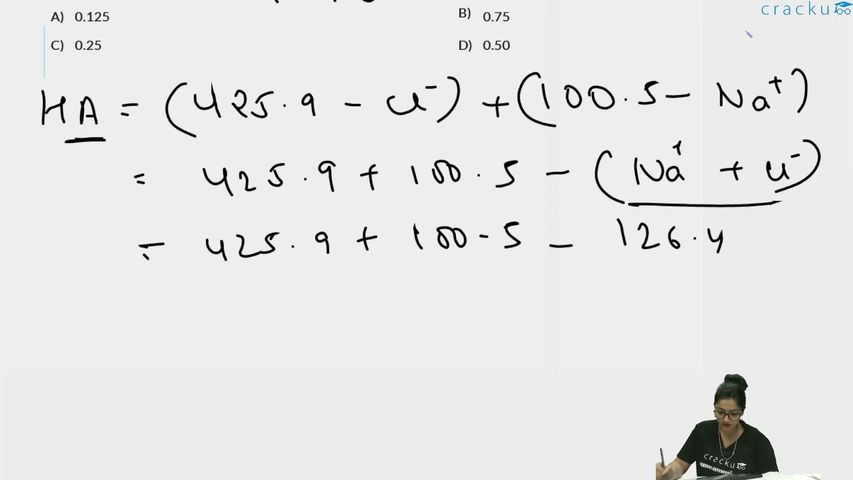
Now, the required molar conductivity at infinite dilution for the weak acid HA is
$$\Lambda_m^{\circ}(\text{HA}) = z + w$$
Substituting the expressions for $$z$$ and $$w$$ we get
$$\Lambda_m^{\circ}(\text{HA}) = (299.5 + x) + (100.5 - x) = 400.0\ \text{S cm}^2\text{ mol}^{-1}$$
Next we calculate the molar conductivity at the given concentration. The relation used is
$$\Lambda_m = \frac{\kappa \times 1000}{c}$$
where $$\kappa$$ is the specific conductivity and $$c$$ is the molarity.
For the solution we have $$\kappa = 5 \times 10^{-5}\ \text{S cm}^{-1}$$ and $$c = 0.001\ \text{mol L}^{-1}$$. Thus,
$$\Lambda_m = \frac{5 \times 10^{-5} \times 1000}{0.001}$$
First multiply $$5 \times 10^{-5}$$ by $$1000 = 10^3$$:
$$5 \times 10^{-5} \times 10^3 = 5 \times 10^{-2} = 0.05$$
Then divide by $$0.001 = 10^{-3}$$:
$$\Lambda_m = \frac{0.05}{0.001} = 50\ \text{S cm}^2\text{ mol}^{-1}$$
The degree of dissociation $$\alpha$$ of the weak acid is obtained from
$$\alpha = \frac{\Lambda_m}{\Lambda_m^{\circ}}$$
Substituting the values:
$$\alpha = \frac{50}{400} = 0.125$$
Hence, the correct answer is Option A.
Was this solution helpful?
Click on the Email ☝️ to Watch the Video Solution
Create a FREE account and get:
_1.webp)

Educational materials for JEE preparation

Ask our AI anything

AI can make mistakes. Please verify important information.
AI can make mistakes. Please verify important information.


