
Join Our JEE Preparation Group
Prep with like-minded aspirants; Get access to free daily tests and study material.
Sign in
Please select an account to continue using cracku.in
↓ →
Join Our JEE Preparation Group
Prep with like-minded aspirants; Get access to free daily tests and study material.
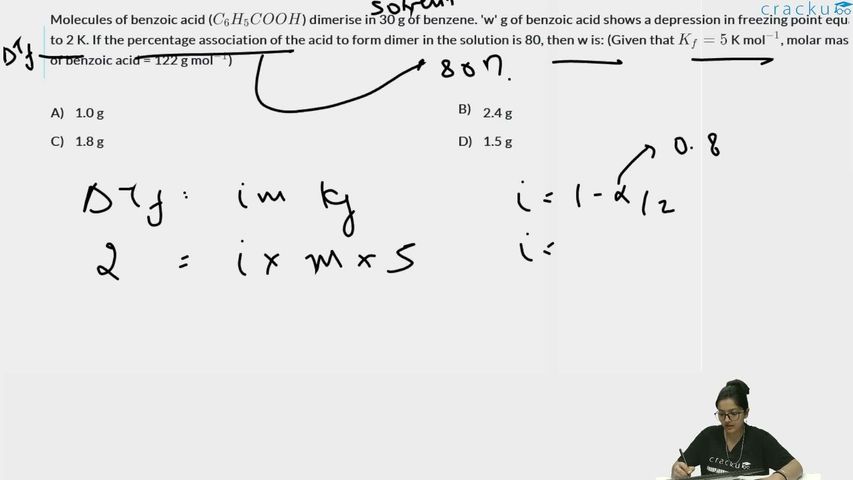
Molecules of benzoic acid ($$C_6H_5COOH$$) dimerise in 30 g of benzene. 'w' g of benzoic acid shows a depression in freezing point equal to 2 K. If the percentage association of the acid to form dimer in the solution is 80, then w is: (Given that $$K_f = 5$$ K mol$$^{-1}$$, molar mass of benzoic acid = 122 g mol$$^{-1}$$)
We have a solution containing w grams of benzoic acid dissolved in 30 g = 0.03 kg of benzene. The observed depression in freezing point is $$\Delta T_f = 2\ \text{K}$$.
For any dilute solution the freezing-point depression is given by the formula
$$\Delta T_f = i\,K_f\,m,$$
where $$i$$ is the van’t Hoff factor that counts the effective number of solute particles, $$K_f$$ is the cryoscopic constant of the solvent, and $$m$$ is the molality of the solute.
The cryoscopic constant is supplied as $$K_f = 5\ \text{K\,kg\,mol}^{-1}$$. Now we express the molality in terms of the unknown mass w of benzoic acid.
The molar mass of benzoic acid is $$M = 122\ \text{g\,mol}^{-1}$$, so the number of moles present is
$$\text{moles of acid} = \frac{w}{122}\ \text{mol}.$$
The solvent mass is 0.03 kg, therefore the molality is
$$m = \frac{\dfrac{w}{122}}{0.03} = \frac{w}{122 \times 0.03} = \frac{w}{3.66}\ \text{mol\,kg}^{-1}.$$
Benzoic acid molecules associate to form dimers, and the question states that the percentage association is 80 %. Let $$\alpha$$ be the degree of association; hence $$\alpha = 0.80$$.
For dimerisation ($$2\text{A}\;\rightleftharpoons\;\text{A}_2$$) the van’t Hoff factor is obtained from
$$i = 1 - \tfrac{\alpha}{2},$$
because every two monomers combine to give one dimer, reducing the total number of solute particles. Substituting $$\alpha = 0.80$$ we get
$$i = 1 - \frac{0.80}{2} = 1 - 0.40 = 0.60.$$
Now we substitute all the known quantities into the freezing-point depression equation:
$$\Delta T_f = i\,K_f\,m \quad\Longrightarrow\quad 2 = 0.60 \times 5 \times \frac{w}{3.66}.$$
First evaluate the product $$0.60 \times 5 = 3$$, so
$$2 = 3 \times \frac{w}{3.66}.$$
Rearranging for w gives
$$w = 2 \times \frac{3.66}{3} = 2 \times 1.22 = 2.44\ \text{g}.$$
On rounding to the significant digits provided in the options, we report $$w \approx 2.4\ \text{g}.$$
Hence, the correct answer is Option B.
Was this solution helpful?
Click on the Email ☝️ to Watch the Video Solution
Create a FREE account and get:
_1.webp)

Educational materials for JEE preparation

Ask our AI anything

AI can make mistakes. Please verify important information.
AI can make mistakes. Please verify important information.


