
Join Our JEE Preparation Group
Prep with like-minded aspirants; Get access to free daily tests and study material.
Sign in
Please select an account to continue using cracku.in
↓ →
Join Our JEE Preparation Group
Prep with like-minded aspirants; Get access to free daily tests and study material.
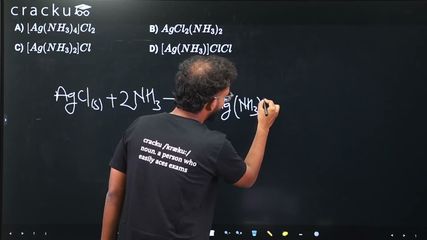
When white precipitate of AgCl is treated with aqueous ammonia, it dissolves due to the formation of a soluble complex.
Write the dissolution reaction: $$AgCl(s) + 2NH_3(aq) \rightarrow [Ag(NH_3)_2]^+(aq) + Cl^-(aq)$$
The overall product can be written as $$[Ag(NH_3)_2]Cl$$.
Identify the complex formed: Silver(I) has a coordination number of 2 with ammonia as the ligand. The complex ion formed is the diamminesilver(I) ion, $$[Ag(NH_3)_2]^+$$, with chloride as the counter ion.
The complete formula is $$[Ag(NH_3)_2]Cl$$.
Evaluate the options: Option A: $$[Ag(NH_3)_4]Cl_2$$ — Incorrect. Silver(I) does not form a tetraammine complex, and the charge balance is wrong (Ag is +1, not +2).
Option B: $$AgCl_2(NH_3)_2$$ — Incorrect. This is not a valid coordination compound representation.
Option C: $$[Ag(NH_3)_2]Cl$$ — Correct. This is the diamminesilver(I) chloride complex.
Option D: $$[Ag(NH_3)]ClCl$$ — Incorrect. Silver forms a complex with 2 ammonia molecules, not 1.
The correct answer is Option C: $$[Ag(NH_3)_2]Cl$$.
Was this solution helpful?
Click on the Email ☝️ to Watch the Video Solution
Create a FREE account and get:
_1.webp)

Educational materials for JEE preparation

Ask our AI anything

AI can make mistakes. Please verify important information.
AI can make mistakes. Please verify important information.
