Join Our JEE Preparation Group
Prep with like-minded aspirants; Get access to free daily tests and study material.
Sign in
Please select an account to continue using cracku.in
↓ →
Join Our JEE Preparation Group
Prep with like-minded aspirants; Get access to free daily tests and study material.
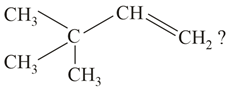
The molecule is 3,3-dimethylbut-1-ene. When this alkene undergoes a typical electrophilic addition reaction, such as hydration with an acid catalyst or reaction with a hydrogen halide like $$HBr$$ or $$HI$$, the process is entirely dictated by the formation and rearrangement of a carbocation intermediate to achieve maximum thermodynamic stability.
The reaction begins when the electron-rich pi bond of the alkene attacks an electrophile, typically a proton ($$H^+$$). According to Markovnikov's rule, the proton adds to the terminal carbon atom (the $$CH_2$$ group at the end of the double bond). This specific placement is favored because it leaves the resulting positive charge on the adjacent, more substituted internal carbon atom. This initial step forms a secondary carbocation, where the positively charged carbon is directly bonded to two other carbon groups.
While secondary carbocations have a moderate level of stability, this specific molecule has a structural feature that allows it to reach a much lower, more stable energy state. Immediately adjacent to the positively charged secondary carbon is a quaternary carbon atom, which is densely packed with three attached methyl groups. Because the molecule is dynamic, it will spontaneously rearrange to relieve energy. An entire methyl group, along with its bonding pair of electrons, physically migrates from the quaternary carbon over to the adjacent positively charged carbon. This fundamental organic mechanism is known as a 1,2-methyl shift.
When the methyl group moves, the positive charge shifts back to the carbon that just lost the group. The newly formed intermediate is now a tertiary carbocation, meaning the positively charged carbon is bonded to three other carbon atoms. This tertiary carbocation is significantly more stable than the initial secondary one. This massive boost in stability is primarily due to hyperconjugation, an effect where the electron density from the numerous adjacent carbon-hydrogen bonds partially overlaps with and stabilizes the empty p-orbital of the positive carbon.
Because the tertiary carbocation is so exceptionally stable, the 1,2-methyl shift happens very rapidly. The final step of the reaction occurs when a nucleophile in the solution, such as a bromide ion or a water molecule, attacks this stable tertiary center, resulting in a rearranged major product rather than a simple addition product. Thus, the correct option is B.
Was this solution helpful?
Create a FREE account and get:
_1.webp)

Educational materials for JEE preparation

Ask our AI anything

AI can make mistakes. Please verify important information.
AI can make mistakes. Please verify important information.