
Join Our JEE Preparation Group
Prep with like-minded aspirants; Get access to free daily tests and study material.
Sign in
Please select an account to continue using cracku.in
↓ →
Join Our JEE Preparation Group
Prep with like-minded aspirants; Get access to free daily tests and study material.
The total number of chiral molecules formed from one molecule of P on complete ozonolysis (O$$_3$$, Zn/H$$_2$$O) is _______.
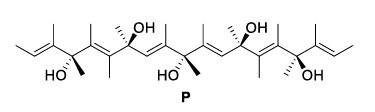
Correct Answer: 2
The structure of compound P is pent-3-en-2-ol, $$CH_3CH=CHCH(OH)CH_3$$. It contains one carbon-carbon double bond and one hydroxyl (-OH) group.
Step 1 (Cleavage of the C=C bond)
Under complete ozonolysis followed by reductive work-up (O$$\_3$$, Zn/H$$\_2$$O), every carbon of the C=C bond is converted into a carbonyl centre. Hence
$$CH_3CH=CHCH(OH)CH_3 \xrightarrow[H_2O]{O_3/Zn} CH_3CHO + CH_3CH(OH)CHO$$
Therefore, one molecule of P gives two organic fragments:
• Acetaldehyde, $$CH_3CHO$$ (achiral, because the carbonyl carbon is attached to two identical atoms—oxygen on one side and nothing else asymmetric).
• 2-Hydroxypropanal, $$CH_3CH(OH)CHO$$.
Step 2 (Checking chirality of each product)
For acetaldehyde there is no stereogenic (asymmetric) carbon, so it is achiral.
In 2-hydroxypropanal the middle carbon (shown in bold) $$CH_3\mathbf{C}H(OH)CHO$$ is attached to four different groups: $$CH_3$$, $$H$$, $$OH$$ and $$CHO$$. Thus it is a stereogenic centre and the molecule exists as two non-superimposable mirror images (enantiomers), labelled R and S.
Step 3 (Total count of distinct chiral molecules)
Because 2-hydroxypropanal forms one pair of enantiomers, the number of different chiral molecules obtained from a single molecule of P is 2.
Hence, the total number of chiral molecules produced is 2.
Was this solution helpful?
Create a FREE account and get:
_1.webp)

Educational materials for JEE preparation

Ask our AI anything

AI can make mistakes. Please verify important information.
AI can make mistakes. Please verify important information.
