Join Our JEE Preparation Group
Prep with like-minded aspirants; Get access to free daily tests and study material.
Sign in
Please select an account to continue using cracku.in
↓ →
Join Our JEE Preparation Group
Prep with like-minded aspirants; Get access to free daily tests and study material.
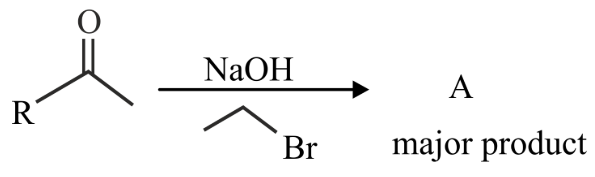
The reaction shown is an $$\mathrm{\alpha}$$-alkylation of a methyl ketone.
The starting ketone is:
$$\mathrm{R-CO-CH_3}$$
In the presence of sodium hydroxide:
$$\mathrm{NaOH}$$
one of the acidic $$\mathrm{\alpha}$$-hydrogens is removed to form a resonance-stabilised enolate ion.
$$\mathrm{R-CO-CH_3 + OH^- \longrightarrow R-CO-CH_2^- + H_2O}$$
The enolate ion then reacts with ethyl bromide:
$$\mathrm{CH_3CH_2Br}$$
through an $$\mathrm{S_N2}$$ substitution reaction.
The negatively charged $$\mathrm{\alpha}$$-carbon attacks the ethyl group and displaces bromide ion.
$$\mathrm{R-CO-CH_2^- + CH_3CH_2Br \longrightarrow R-CO-CH_2CH_2CH_3 + Br^-}$$
Thus, the original methyl group $$\mathrm{(-CH_3)}$$ is converted into a propyl chain:
$$\mathrm{(-CH_2CH_2CH_3)}$$
attached to the carbonyl carbon.
Therefore, the correct product is:
$$\boxed{\mathrm{Structure\ C}}$$
Was this solution helpful?
Click on the Email ☝️ to Watch the Video Solution
Create a FREE account and get:
_1.webp)

Educational materials for JEE preparation

Ask our AI anything

AI can make mistakes. Please verify important information.
AI can make mistakes. Please verify important information.