Join WhatsApp Icon JEE WhatsApp Group
Question 44

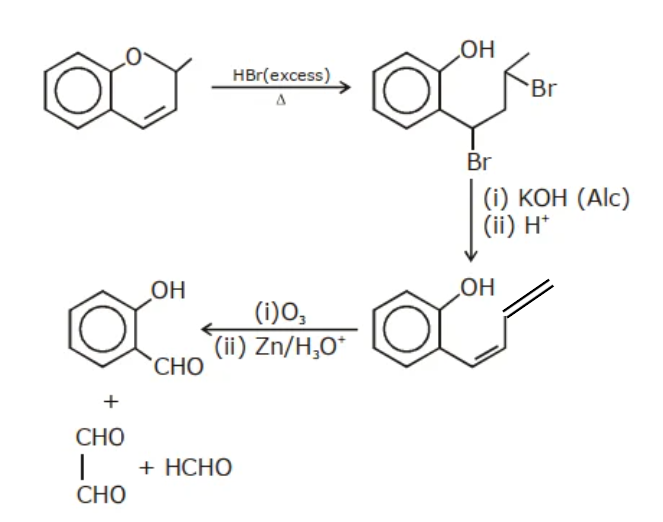
The major aromatic product C in the following reaction sequence will be:

image

image
  • Step 1: Reaction with excess $$\text{HBr}$$ and heat ($$\Delta$$)

    • The starting cyclic ether is protonated by $$\text{HBr}$$, followed by a nucleophilic attack by $$\text{Br}^-$$ to cleave the ether ring. This forms a phenolic group ($$-\text{OH}$$) on the benzene ring and an alkyl bromide intermediate.
    • Since $$\text{HBr}$$ is in excess, it undergoes an addition reaction across the double bond of the side chain according to Markovnikov's rule.
    • This gives the intermediate product A, which is a vicinal dibromide with a phenolic group: $$\text{C}_6\text{H}_4(\text{OH})(\text{CH(Br)CH(Br)CH}_3)$$

  • Step 2: Reaction with alcoholic $$\text{KOH}$$ followed by acidic workup ($$\text{H}^+$$)

    • Alcoholic $$\text{KOH}$$ is a strong dehydrohalogenating agent. It carries out a double elimination ($$-2\text{HBr}$$) on the vicinal dibromide chain to form a triple bond (alkyne).
    • The resulting intermediate B contains a terminal or internal alkyne attached to the benzene ring alongside the phenol group. Under these conditions, the conjugated structure stabilizes as an allylic/propargyl double bond system: $$\text{C}_6\text{H}_4(\text{OH})(\text{CH}=\text{CH}\text{--CH}_3)$$

  • Step 3: Ozonolysis with (i) $$\text{O}_3$$ and (ii) $$\text{Zn/H}_3\text{O}^+$$

    • This is a reductive ozonolysis step that selectively cleaves the carbon-carbon double bond ($$\text{C}=\text{C}$$) in the side chain.
    • The double bond is broken and replaced with carbonyl ($$\text{C}=\text{O}$$) groups on both fragments: $$\text{C}_6\text{H}_4(\text{OH})(\text{CH}=\text{CH}\text{--CH}_3) \xrightarrow{\text{O}_3, \ \text{Zn/H}_3\text{O}^+} \text{C}_6\text{H}_4(\text{OH})(\text{CHO}) + \text{CH}_3\text{CHO}$$
    • The side chain is chopped down to an aldehyde group ($$-\text{CHO}$$) attached directly to the benzene ring at the position adjacent (ortho) to the hydroxyl group. This aromatic product is known as Salicylaldehyde (2-hydroxybenzaldehyde).

Conclusion:

The sequence converts the cyclic core through opening, double elimination, and ozonolytic cleavage to yield a substituted benzene ring featuring both an explicit phenol and a newly formed aldehyde function. This perfectly matches the molecule highlighted in the solution panel.

Answer: Option A — Salicylaldehyde (2-hydroxybenzaldehyde)
Get AI Help

Video Solution

video

Create a FREE account and get:

  • Free JEE Mains Previous Papers PDF
  • Take JEE Mains paper tests

JEE Quant Questions | JEE Quantitative Ability

JEE DILR Questions | LRDI Questions For JEE

JEE Verbal Ability Questions | VARC Questions For JEE

Free JEE Topicwise Questions

JEE Rotational MotionJEE Units & MeasurementsJEE Atomic StructureJEE GravitationJEE Periodic Table & PeriodicityJEE StatisticsJEE Inverse Trigonometric FunctionsJEE Magnetism & Magnetic MaterialsJEE Sequences & SeriesJEE MatricesJEE Alternating CurrentsJEE Carboxylic AcidsJEE Permutations & CombinationsJEE Work, Energy & PowerJEE Electromagnetic InductionJEE Electronic DevicesJEE d and f-Block ElementsJEE Chemical KineticsJEE Heat TransferJEE Three Dimensional GeometryJEE Magnetic Effects of CurrentJEE Hydrocarbons - AromaticJEE Electromagnetic WavesJEE Aldehydes & KetonesJEE Hydrocarbons - AlkanesJEE Applications of DerivativesJEE EquilibriumJEE Indefinite IntegrationJEE Chemical ThermodynamicsJEE ElectrochemistryJEE ProbabilityJEE BiomoleculesJEE Continuity & DifferentiabilityJEE Kinetic Theory of GasesJEE Vector AlgebraJEE Hydrocarbons - AlkynesJEE Differential EquationsJEE Current & ResistanceJEE Straight LinesJEE WavesJEE Redox ReactionsJEE Hydrocarbons - AlkenesJEE DeterminantsJEE SolutionsJEE Ray OpticsJEE Dual Nature of Matter & RadiationJEE Chemical Bonding & Molecular StructureJEE Complex NumbersJEE Sets, Relations & FunctionsJEE Electric Charges & FieldsJEE Laws of MotionJEE Fluid MechanicsJEE Basic Concepts in ChemistryJEE Trigonometric FunctionsJEE LimitsJEE Laws of ThermodynamicsJEE Kinematics - 2D MotionJEE p-Block Elements (Groups 13-18)JEE Simple Harmonic MotionJEE Electric Potential & CapacitanceJEE Coordination CompoundsJEE JEE 2D GeometryJEE CirclesJEE Definite IntegrationJEE EMF & Circuit AnalysisJEE Surface TensionJEE Atoms & NucleiJEE Laboratory Experiments - XIJEE Number SystemJEE Basic Principles of Organic ChemistryJEE Wave OpticsJEE Quadratic EquationsJEE Alcohols, Phenols & EthersJEE Organic Compounds with HalogensJEE DifferentiationJEE Conic SectionsJEE Nitrogen-Containing CompoundsJEE ElasticityJEE Practical Organic ChemistryJEE Kinematics - 1D MotionJEE Purification & CharacterisationJEE Binomial Theorem
Ask AI