
Join Our JEE Preparation Group
Prep with like-minded aspirants; Get access to free daily tests and study material.
Sign in
Please select an account to continue using cracku.in
↓ →
Join Our JEE Preparation Group
Prep with like-minded aspirants; Get access to free daily tests and study material.
Consider the following reactions:
(i) Glucose + ROH $$\xrightarrow{dry \; HCl}$$ Acetal $$\xrightarrow{x \; eq. \; of \; (CH_3CO)_2O}$$ acetyl derivative
(ii) Glucose $$\xrightarrow{Ni/H_2}$$ A $$\xrightarrow{y \; eq. \; of \; (CH_3CO)_2O}$$ acetyl derivative
(iii) Glucose $$\xrightarrow{z \; eq. \; of \; (CH_3CO)_2O}$$ acetyl derivative
'x', 'y' and 'z' in these reactions are respectively:
We start with the basic fact that one molecule of acetic anhydride, $$\left(CH_3CO\right)_2O$$, can furnish one acetyl group $$\left(CH_3CO-\right)$$ to one hydroxyl (-OH) group of an organic compound and at the same time liberates one molecule of acetic acid. Therefore, the number of equivalents of acetic anhydride required for complete acetylation is exactly the same as the number of free -OH groups present in the substrate.
Glucose in its open-chain form is an aldo-hexose. It possesses:
• one aldehydic carbonyl group (-CHO), and
• five alcoholic hydroxyl groups (at C2, C3, C4, C5 and C6).
Now we analyse each sequence separately.
(i) Glucose + ROH $$\overset{dry\;HCl}{\rightarrow}$$ Acetal
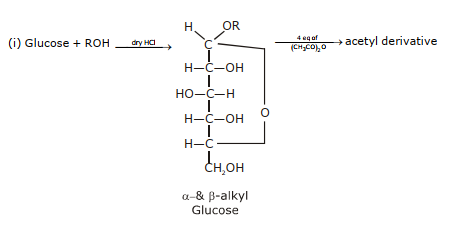
Dry HCl in an alcohol converts the aldehyde end of glucose into an acetal (more precisely, an alkyl glucoside). The mechanism replaces the anomeric hydroxyl group (the one originally formed in the hemiacetal ring) by an -OR group from the alcohol.
Effect on the -OH count:
• The anomeric -OH is lost (converted to -OR, an ether).
• The remaining four secondary -OH groups stay intact.
Hence the acetal now contains exactly $$5 - 1 = 4$$ free hydroxyl groups.
Therefore, the number of equivalents of acetic anhydride needed is
$$x = 4.$$
(ii) Glucose $$\overset{Ni/H_2}{\rightarrow}$$ A (Sorbitol)
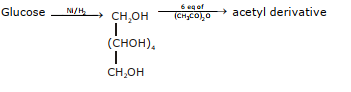
Hydrogenation over Ni reduces the aldehyde group (-CHO) at C1 to the corresponding primary alcohol (-CH2OH). No other part of the molecule is affected.
Effect on the -OH count:
• The original carbonyl carbon now bears an additional hydroxyl group.
• All the original five -OH groups remain.
So the total number of -OH groups becomes
$$5 + 1 = 6.$$
Consequently, the equivalents of acetic anhydride required are
$$y = 6.$$
(iii) Direct acetylation of glucose

When glucose is treated directly with acetic anhydride in the presence of a base such as pyridine, every free hydroxyl group is acetylated. The aldehyde carbonyl itself is not modified, but the anomeric hydroxyl (present in the cyclic hemiacetal form) is indeed a free -OH and does get acetylated.
Thus, all five hydroxyl groups are converted to O-COCH3 groups.
Hence the required equivalents are
$$z = 5.$$
Collecting the three values we have
$$x = 4, \; y = 6, \; z = 5.$$
The only option that lists the trio 4, 6 and 5 in this order is Option B.
Hence, the correct answer is Option B.
Was this solution helpful?
Create a FREE account and get:
_1.webp)

Educational materials for JEE preparation

Ask our AI anything

AI can make mistakes. Please verify important information.
AI can make mistakes. Please verify important information.
