
Join Our JEE Preparation Group
Prep with like-minded aspirants; Get access to free daily tests and study material.
Sign in
Please select an account to continue using cracku.in
↓ →
Join Our JEE Preparation Group
Prep with like-minded aspirants; Get access to free daily tests and study material.
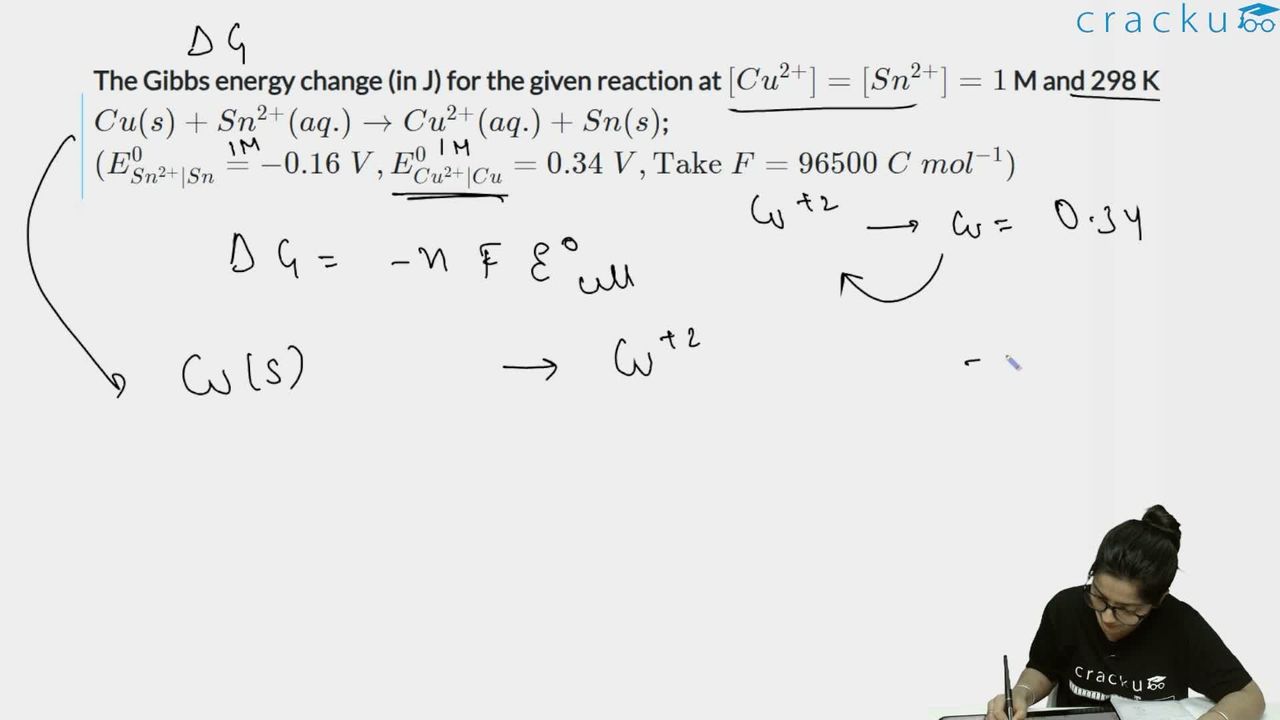
The Gibbs energy change (in J) for the given reaction at $$[Cu^{2+}] = [Sn^{2+}] = 1$$ M and 298 K is:
$$Cu(s) + Sn^{2+}(aq.) \to Cu^{2+}(aq.) + Sn(s)$$;
$$(E^0_{Sn^{2+}|Sn} = -0.16 \; V, E^0_{Cu^{2+}|Cu} = 0.34 \; V, \text{Take } F = 96500 \; C \; mol^{-1})$$
Correct Answer: 96500
The relationship between the standard Gibbs energy change and the standard cell potential ($$E^\circ_{\text{cell}}$$) is given by the formula:
$$\Delta G^\circ = -nFE^\circ_{\text{cell}}$$
Where:
Step 1: Determine the Number of Transferred Electrons ($$n$$)
Let's look at the given cell reaction:
$$\text{Cu}_{(s)} + \text{Sn}^{2+}_{(aq)} \rightarrow \text{Cu}^{2+}_{(aq)} + \text{Sn}_{(s)}$$By splitting the process into half-reactions, we can see the total electron exchange:
Thus, exactly $$n = 2$$ moles of electrons are transferred.
Step 2: Calculate the Standard Cell Potential ($$E^\circ_{\text{cell}}$$)
Using the standard reduction potentials provided for the half-cells:
$$E^\circ_{\text{cell}} = E^\circ_{\text{cathode}} - E^\circ_{\text{anode}}$$ $$E^\circ_{\text{cell}} = E^\circ_{\text{Sn}^{2+}/\text{Sn}} - E^\circ_{\text{Cu}^{2+}/\text{Cu}}$$ $$E^\circ_{\text{cell}} = -0.16 \text{ V} - 0.34 \text{ V} = -0.50 \text{ V}$$Step 3: Compute the Gibbs Energy Change ($$\Delta G^\circ$$)
Substitute the values of $$n$$, $$F$$, and $$E^\circ_{\text{cell}}$$ into our main thermodynamic formula:
$$\Delta G^\circ = -(2) \times (96500 \text{ C mol}^{-1}) \times (-0.50 \text{ V})$$ $$\Delta G^\circ = +96500 \text{ J}$$Because the calculated standard cell potential is negative, the reaction is non-spontaneous in the forward direction, resulting in a positive Gibbs free energy value of $$96500 \text{ J}$$.
Answer: 96500
Was this solution helpful?
Click on the Email ☝️ to Watch the Video Solution
Create a FREE account and get:
_1.webp)

Educational materials for JEE preparation

Ask our AI anything

AI can make mistakes. Please verify important information.
AI can make mistakes. Please verify important information.
