
Join Our JEE Preparation Group
Prep with like-minded aspirants; Get access to free daily tests and study material.
Sign in
Please select an account to continue using cracku.in
↓ →
Join Our JEE Preparation Group
Prep with like-minded aspirants; Get access to free daily tests and study material.
The internal energy change (in J) when 90 g of water undergoes complete evaporation at 100$$°$$C is ___________.
(Given: $$\Delta H_{vap}$$ for water at 373 K $$= 41$$ kJ/mol, R $$= 8.314$$ J K$$^{-1}$$ mol$$^{-1}$$)
Correct Answer: 189494
We are asked to find the change in internal energy, $$\Delta U$$, when water changes from liquid to vapour at its boiling point. The data supplied are the enthalpy of vaporisation $$\Delta H_{vap}=41\;\text{kJ mol}^{-1}$$ at 373 K and the gas-constant $$R=8.314\;\text{J K}^{-1}\text{ mol}^{-1}$$.
For any process carried out at constant pressure, the relation between enthalpy change and internal-energy change is
$$\Delta H=\Delta U+\Delta n_{\text{gas}}RT$$
where $$\Delta n_{\text{gas}}$$ is the change in the number of moles of gaseous species. We rearrange this to obtain
$$\Delta U=\Delta H-\Delta n_{\text{gas}}RT$$
Now we evaluate each term one by one.
Number of moles of water
We have 90 g of water. The molar mass of water is 18 g mol−1, so
$$n=\frac{\text{mass}}{\text{molar mass}} =\frac{90\;\text{g}}{18\;\text{g mol}^{-1}} =5\;\text{mol}$$
Enthalpy change
The enthalpy of vaporisation is given per mole. Therefore, for 5 mol,
$$\Delta H = n\,\Delta H_{vap} =5\;\text{mol}\times 41\;\text{kJ mol}^{-1} =205\;\text{kJ} =205\,000\;\text{J}$$
Change in the number of gaseous moles
Initially the water is a liquid, so the number of gaseous moles is zero. After evaporation, all 5 mol become vapour. Hence
$$\Delta n_{\text{gas}} = 5-0 = 5$$
Evaluation of $$\Delta n_{\text{gas}}RT$$
$$\Delta n_{\text{gas}}RT = 5 \times 8.314\;\text{J K}^{-1}\text{ mol}^{-1}\times 373\;\text{K}$$
We multiply step by step:
$$8.314\times 373 = 3101.122\;\text{J mol}^{-1}$$
$$5\times 3101.122 = 15\,505.61\;\text{J}$$
Finally, the internal energy change
$$\Delta U = \Delta H - \Delta n_{\text{gas}}RT = 205\,000\;\text{J} - 15\,505.61\;\text{J} = 189\,494.39\;\text{J}$$
The value rounds to
$$\Delta U \approx 189\,494\;\text{J}$$
So, the answer is $$189\,494\;\text{J}$$.
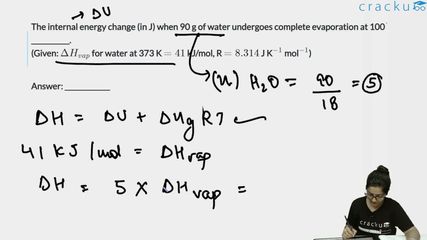
Click on the Email ☝️ to Watch the Video Solution
Create a FREE account and get:
_1.webp)

Educational materials for JEE preparation

Ask our AI anything

AI can make mistakes. Please verify important information.
AI can make mistakes. Please verify important information.


