Join Our JEE Preparation Group
Prep with like-minded aspirants; Get access to free daily tests and study material.
Sign in
Please select an account to continue using cracku.in
↓ →
Join Our JEE Preparation Group
Prep with like-minded aspirants; Get access to free daily tests and study material.
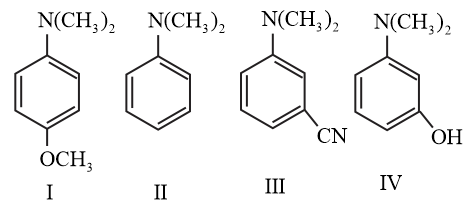
To determine the increasing order of $$pK_b$$ values, we compare the basicity of the given N,N-dimethylaniline derivatives by examining the electronic effects of the substituents present on the aromatic ring.
The basicity of an amine depends on the availability of the lone pair of electrons on the nitrogen atom for protonation. Electron-donating groups (EDGs) increase the electron density on nitrogen and make the amine more basic, whereas electron-withdrawing groups (EWGs) decrease the electron density and reduce its basicity.
Since $$pK_b$$ is inversely related to basicity, a stronger base has a lower $$pK_b$$, while a weaker base has a higher $$pK_b$$.
Compound (I) contains a para-methoxy group $$\left(-OCH_3\right)$$. The methoxy group exhibits a strong $$+R$$ (resonance donating) effect and a relatively weak $$-I$$ (inductive withdrawing) effect. At the para position, the resonance effect predominates, increasing the electron density on the nitrogen atom and making this compound the strongest base among the four. Consequently, it possesses the lowest $$pK_b$$.
Compound (II) is unsubstituted N,N-dimethylaniline and serves as the reference compound with no additional electron-donating or electron-withdrawing substituents.
Compound (IV) contains a meta-hydroxy group $$\left(-OH\right)$$. At the meta position, resonance interaction with the amino group is not possible, so only the $$-I$$ effect operates. This inductive withdrawal decreases the electron density on nitrogen, making the compound less basic than the unsubstituted derivative.
Compound (III) contains a meta-cyano group $$\left(-CN\right)$$. Like the meta-hydroxy group, resonance effects do not operate through the meta position, leaving only the inductive effect. The cyano group is a much stronger electron-withdrawing substituent than the hydroxyl group, causing the greatest decrease in electron density on nitrogen. Therefore, it is the weakest base and has the highest $$pK_b$$.
The order of basicity is therefore
$$\boxed{\text{I} > \text{II} > \text{IV} > \text{III}}.$$
Since $$pK_b$$ is inversely proportional to basicity, the increasing order of $$pK_b$$ values is
$$\boxed{\text{I} < \text{II} < \text{IV} < \text{III}}.$$
Hence, the correct order is
$$\boxed{\text{I} < \text{II} < \text{IV} < \text{III}}.$$
Create a FREE account and get:
_1.webp)

Educational materials for JEE preparation

Ask our AI anything

AI can make mistakes. Please verify important information.
AI can make mistakes. Please verify important information.