Join Our JEE Preparation Group
Prep with like-minded aspirants; Get access to free daily tests and study material.
Sign in
Please select an account to continue using cracku.in
↓ →
Join Our JEE Preparation Group
Prep with like-minded aspirants; Get access to free daily tests and study material.
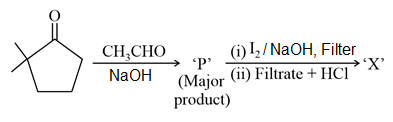
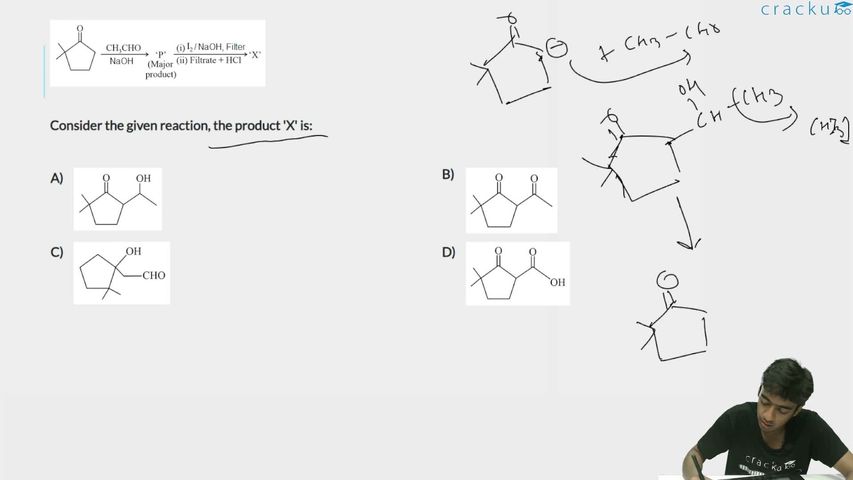
The reaction sequence involves a crossed aldol addition followed by the haloform reaction.
First, $$\mathrm{NaOH}$$ deprotonates the only available $$\mathrm{\alpha}$$-position of $$\mathrm{2,2\text{-}Dimethylcyclopentan\text{-}1\text{-}one}$$ to form an enolate ion.
This enolate attacks the carbonyl carbon of acetaldehyde, producing intermediate $$\mathrm{P}$$, a $$\mathrm{\beta}$$-hydroxy ketone containing the group $$\mathrm{(-CH(OH)-CH_3)}$$.
Intermediate $$\mathrm{P}$$ is then treated with $$\mathrm{I_2/NaOH}$$, initiating the iodoform reaction.
Sodium hypoiodite first oxidises the secondary alcohol into a methyl ketone.
The methyl group undergoes tri-iodination followed by cleavage to form yellow precipitate:
$$\mathrm{CHI_3}$$
and a sodium carboxylate salt.
Filtration removes the iodoform precipitate.
Acidification with $$\mathrm{HCl}$$ protonates the carboxylate ion to form the corresponding carboxylic acid.
The final major product $$\mathrm{X}$$ is:
$$\mathrm{2,2\text{-}Dimethyl\text{-}5\text{-}carboxycyclopentan\text{-}1\text{-}one}$$
Was this solution helpful?
Click on the Email ☝️ to Watch the Video Solution
Create a FREE account and get:
_1.webp)

Educational materials for JEE preparation

Ask our AI anything

AI can make mistakes. Please verify important information.
AI can make mistakes. Please verify important information.