Join Our JEE Preparation Group
Prep with like-minded aspirants; Get access to free daily tests and study material.
Sign in
Please select an account to continue using cracku.in
↓ →
Join Our JEE Preparation Group
Prep with like-minded aspirants; Get access to free daily tests and study material.
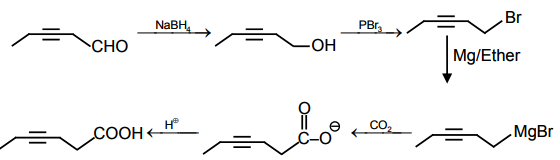
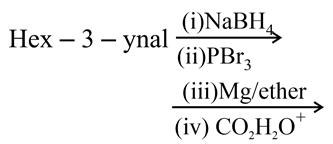
Step 1: Reduction using $$\text{NaBH}_4$$
The starting material is hex-4-enal, which contains both a carbon-carbon double bond ($$\text{C=C}$$) and an aldehyde group ($$\text{--CHO}$$). Sodium borohydride ($$\text{NaBH}_4$$) is a selective reducing agent that reduces carbonyl groups (aldehydes and ketones) to alcohols but does not reduce isolated olefinic double bonds.
$$\text{CH}_3\text{--CH=CH--CH}_2\text{--CH}_2\text{--CHO} \xrightarrow{\text{NaBH}_4} \text{CH}_3\text{--CH=CH--CH}_2\text{--CH}_2\text{--CH}_2\text{--OH}$$The resulting product is an unsaturated primary alcohol: hex-4-en-1-ol.
Step 2: Bromination using $$\text{PBr}_3$$
Phosphorus tribromide ($$\text{PBr}_3$$) is used to convert primary and secondary alcohols into their corresponding alkyl bromides via an $$\text{S}_\text{N}2$$ substitution mechanism, replacing the hydroxyl ($$\text{--OH}$$) group with a bromine ($$\text{--Br}$$) atom.
$$\text{CH}_3\text{--CH=CH--CH}_2\text{--CH}_2\text{--CH}_2\text{--OH} \xrightarrow{\text{PBr}_3} \text{CH}_3\text{--CH=CH--CH}_2\text{--CH}_2\text{--CH}_2\text{--Br}$$The resulting product is 1-bromohex-4-ene.
Step 3: Formation of Grignard Reagent ($$\text{Mg}/\text{Ether}$$)
The alkyl bromide reacts with magnesium turnings in the presence of dry ether to form an organomagnesium compound known as a Grignard reagent. The magnesium inserts into the carbon-bromine bond.
$$\text{CH}_3\text{--CH=CH--CH}_2\text{--CH}_2\text{--CH}_2\text{--Br} \xrightarrow{\text{Mg/Ether}} \text{CH}_3\text{--CH=CH--CH}_2\text{--CH}_2\text{--CH}_2\text{--MgBr}$$The resulting nucleophilic intermediate is hex-4-en-1-ylmagnesium bromide.
Step 4: Carboxylation ($$\text{CO}_2$$ followed by $$\text{H}^+$$)
The nucleophilic carbanion-like carbon bonded to magnesium attacks the electrophilic carbon of carbon dioxide ($$\text{CO}_2$$), forming a carboxylate salt intermediate. Subsequent acidic workup ($$\text{H}^+$$) protonates the carboxylate ion to yield a carboxylic acid containing one additional carbon atom than the starting alkyl halide chain.
$$\text{CH}_3\text{--CH=CH--CH}_2\text{--CH}_2\text{--CH}_2\text{--MgBr} \xrightarrow{\text{CO}_2} \text{CH}_3\text{--CH=CH--CH}_2\text{--CH}_2\text{--CH}_2\text{--COO}^\ominus\text{MgBr}^\oplus$$ $$\text{CH}_3\text{--CH=CH--CH}_2\text{--CH}_2\text{--CH}_2\text{--COO}^\ominus\text{MgBr}^\oplus \xrightarrow{\text{H}^+} \text{CH}_3\text{--CH=CH--CH}_2\text{--CH}_2\text{--CH}_2\text{--COOH}$$The sequential conversion transforms the initial 6-carbon aldehyde into a 7-carbon unsaturated carboxylic acid, keeping the position of the double bond intact. The final product is hept-5-enoic acid ($$\text{CH}_3\text{--CH=CH--CH}_2\text{--CH}_2\text{--CH}_2\text{--COOH}$$).
Answer: hept-5-enoic acid
Was this solution helpful?
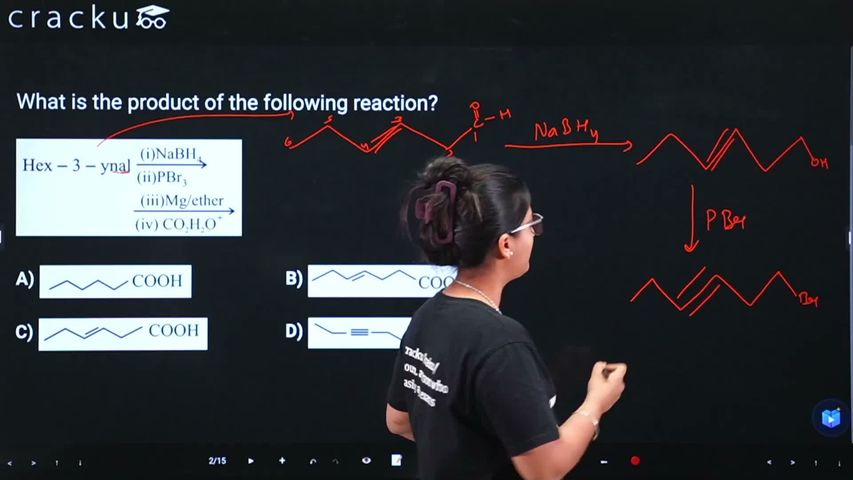
Click on the Email ☝️ to Watch the Video Solution
Create a FREE account and get:
_1.webp)

Educational materials for JEE preparation

Ask our AI anything

AI can make mistakes. Please verify important information.
AI can make mistakes. Please verify important information.