
Join Our JEE Preparation Group
Prep with like-minded aspirants; Get access to free daily tests and study material.
Sign in
Please select an account to continue using cracku.in
↓ →
Join Our JEE Preparation Group
Prep with like-minded aspirants; Get access to free daily tests and study material.
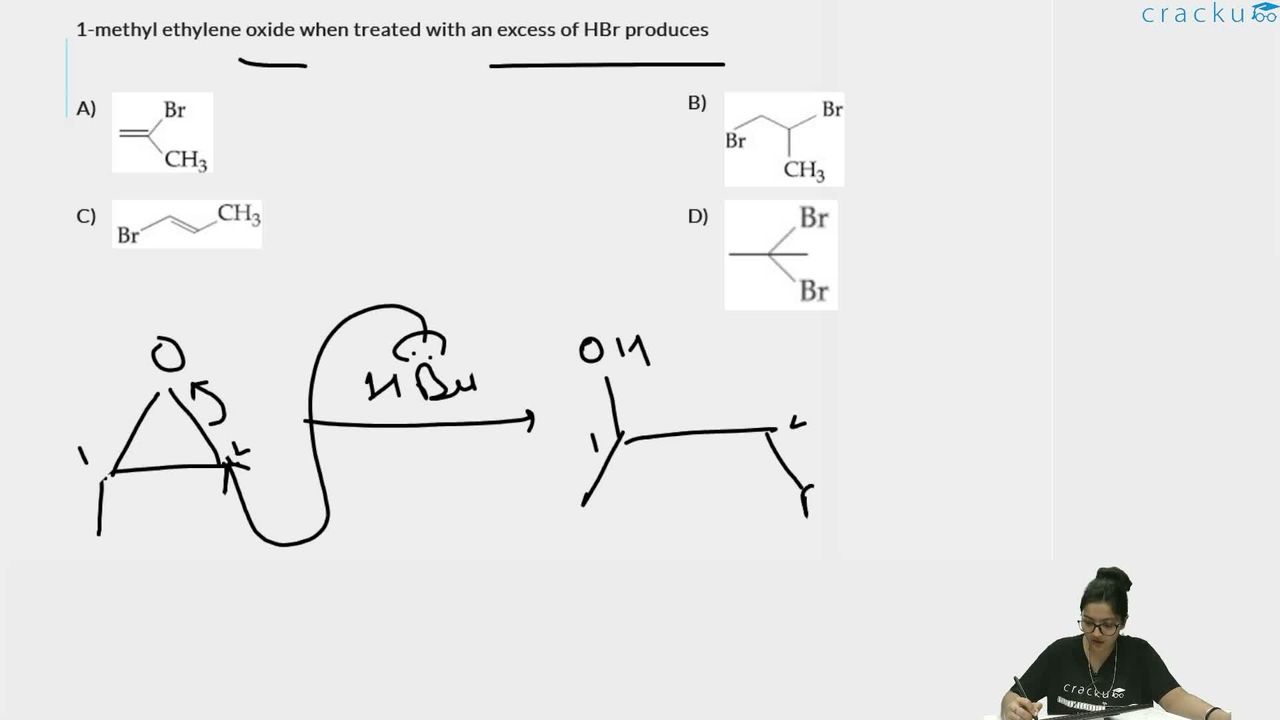
1-methyl ethylene oxide when treated with an excess of HBr produces
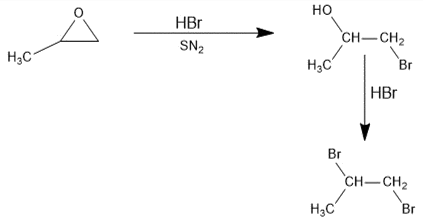
Step 1: Epoxide Ring Opening under Acidic Conditions ($$\text{HBr}$$, $$\text{SN}_2$$)
When 1-methyl ethylene oxide is treated with $$\text{HBr}$$, the oxygen atom of the epoxide ring is first protonated by the strong acid to form a highly reactive oxonium ion intermediate. This protonation increases the electrophilicity of both ring carbon atoms.
Although the reaction follows an $$\text{SN}_2$$-like pathway where the bromide ion ($$\text{Br}^\ominus$$) attacks as a nucleophile, the bond-breaking in a protonated epoxide precedes bond-making. This builds up significant partial positive charge ($$\delta^+$$) on the ring carbons. Because the more substituted secondary ($$2^\circ$$) carbon stabilizes this partial positive charge much better than the primary ($1^\circ$$) carbon, the bromide ion selectively attacks the more substituted secondary carbon:
$$\text{CH}_3\text{--(CH--O--CH}_2\text{)} \xrightarrow{\text{H}^\oplus} \text{CH}_3\text{--(CH--OH}^\oplus\text{--CH}_2\text{)} \xrightarrow{\text{Br}^\ominus} \text{CH}_3\text{--CH(Br)--CH}_2\text{OH}$$This regioselective ring opening yields 1-bromopropan-2-ol as the intermediate.
Step 2: Substitution of the Hydroxyl Group with Excess $$\text{HBr}$$
Because the reaction mixture contains an excess of $$\text{HBr}$$, the remaining secondary alcohol group ($$\text{--OH}$$) in 1-bromopropan-2-ol undergoes a subsequent nucleophilic substitution reaction:
This converts the secondary alcohol into a vicinal dibromide: 1,2-dibromopropane.
Halohydrin Intermediates (e.g., 1-bromopropan-2-ol or 2-bromopropan-1-ol):
Structures that contain a remaining hydroxyl group ($$\text{--OH}$$) alongside a single bromine atom only represent the intermediate species formed after the initial ring opening. They fail to account for the secondary substitution step driven by the specified excess reagent conditions.
Geminal Dibromides (e.g., 1,1-dibromopropane or 2,2-dibromopropane):
Geminal dibromides require both halogens to be added to the exact same carbon atom. The epoxide ring opening naturally distributes functional groups across adjacent carbons (carbons 1 and 2), making geminal placement chemically impossible here.
The combination of regioselective acidic epoxide cleavage followed by acid-catalyzed substitution of the remaining alcohol transforms 1-methyl ethylene oxide completely into 1,2-dibromopropane.
Answer: Option B (1,2-dibromopropane)
Was this solution helpful?
Click on the Email ☝️ to Watch the Video Solution
Create a FREE account and get:
_1.webp)

Educational materials for JEE preparation

Ask our AI anything

AI can make mistakes. Please verify important information.
AI can make mistakes. Please verify important information.


