Join Our JEE Preparation Group
Prep with like-minded aspirants; Get access to free daily tests and study material.
Sign in
Please select an account to continue using cracku.in
↓ →
Join Our JEE Preparation Group
Prep with like-minded aspirants; Get access to free daily tests and study material.
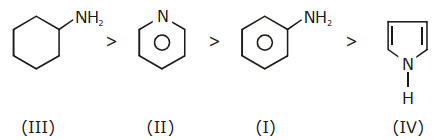
The basicity of an amine or a nitrogenous base is directly proportional to the availability of the lone pair of electrons on the nitrogen atom to accept a proton ($$\text{H}^+$$). If the lone pair is localized on the nitrogen atom, the compound is a stronger base. If the lone pair is delocalized due to resonance or aromaticity, the compound is a significantly weaker base.
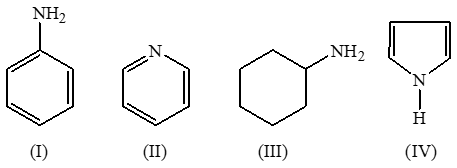
Compound (III): Cyclohexylamine
In cyclohexylamine, the nitrogen atom is bonded to an aliphatic $$sp^3$$ hybridized cyclohexane ring. The lone pair of electrons is completely localized on the nitrogen atom and experiences an electron-donating inductive effect ($$+I$$) from the ring. This makes it the most basic compound in the group.
Compound (II): Pyridine
In pyridine, the nitrogen atom is $$sp^2$$ hybridized and its lone pair resides in an $$sp^2$$ hybrid orbital that lies in the plane of the ring. Because this orbital is perpendicular to the $$\pi$$ system, the lone pair does not participate in aromatic resonance and remains available for protonation. However, since an $$sp^2$$ hybridized nitrogen is more electronegative than an $$sp^3$$ nitrogen, it holds its lone pair more tightly than cyclohexylamine, making it less basic than (III).
Compound (I): Aniline
In aniline, the lone pair on the nitrogen atom is conjugated with the aromatic benzene ring. It undergoes delocalization via resonance into the ring, which drastically reduces its availability for protonation. Thus, aniline is much weaker as a base compared to both cyclohexylamine and pyridine.
Compound (IV): Pyrrole
In pyrrole, the lone pair of electrons on the nitrogen atom is part of the aromatic sextet ($$6\pi$$ electrons) itself. If pyrrole accepts a proton, its aromatic stability is completely destroyed. Because protonation is energetically extremely unfavorable, pyrrole is an exceptionally weak base, making it the least basic compound in the entire set.
Combining the analysis of localization, hybridization, and aromaticity, the decreasing order of basicity is:
$$\text{(III)} > \text{(II)} > \text{(I)} > \text{(IV)}$$
Answer: Option D — (III) > (II) > (I) > (IV)
Was this solution helpful?
Click on the Email ☝️ to Watch the Video Solution
Create a FREE account and get:
_1.webp)

Educational materials for JEE preparation

Ask our AI anything

AI can make mistakes. Please verify important information.
AI can make mistakes. Please verify important information.