
Join Our JEE Preparation Group
Prep with like-minded aspirants; Get access to free daily tests and study material.
Sign in
Please select an account to continue using cracku.in
↓ →
Join Our JEE Preparation Group
Prep with like-minded aspirants; Get access to free daily tests and study material.
In a Young's double slit experiment, three polarizers are kept as shown in the figure. The transmission axes of $$P_1$$ and $$P_2$$ are orthogonal to each other. The polarizer $$P_3$$ covers both the slits with its transmission axis at $$45^\circ$$ to those of $$P_1$$ and $$P_2$$. An unpolarized light of wavelength $$\lambda$$ and intensity $$I_0$$ is incident on $$P_1$$ and $$P_2$$.The intensity at a point after $$P_3$$ where the path difference between the light waves from $$s_1$$ and $$s_2$$ is $$\frac{\lambda}{3}\text{ is:}$$
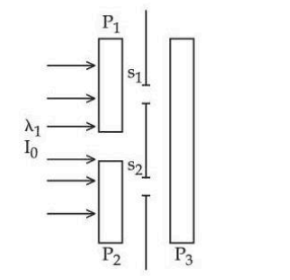
Intensity after passing orthogonal polarizers $$P_1$$ and $$P_2$$:
$$I_1 = I_2 = \frac{I_0}{2}$$
Beams from $$s_1$$ and $$s_2$$ passing through $$P_3$$ at $$45^\circ$$ (using Malus's Law):
$$I_{s1} = I_1 \cos^2(45^\circ) \implies I_{s1} = \frac{I_0}{2} \times \frac{1}{2} = \frac{I_0}{4}$$
$$I_{s2} = I_2 \cos^2(45^\circ) \implies I_{s2} = \frac{I_0}{2} \times \frac{1}{2} = \frac{I_0}{4}$$
Since both beams pass through $$P_3$$, they have parallel transmission axes and can interfere.
$$\Delta x = \frac{\lambda}{3} \implies \phi = \frac{2\pi}{\lambda} \Delta x = \frac{2\pi}{3}$$
Resultant intensity:
$$I_{\text{net}} = I_{s1} + I_{s2} + 2\sqrt{I_{s1}I_{s2}}\cos\phi$$
$$I_{\text{net}} = \frac{I_0}{4} + \frac{I_0}{4} + 2\left(\frac{I_0}{4}\right)\cos\left(\frac{2\pi}{3}\right) \implies I_{\text{net}} = \frac{I_0}{2} + \frac{I_0}{2}\left(-\frac{1}{2}\right) = \frac{I_0}{4}$$
Was this solution helpful?
Create a FREE account and get:
_1.webp)

Educational materials for JEE preparation

Ask our AI anything

AI can make mistakes. Please verify important information.
AI can make mistakes. Please verify important information.
