
Join Our JEE Preparation Group
Prep with like-minded aspirants; Get access to free daily tests and study material.
Sign in
Please select an account to continue using cracku.in
↓ →
Join Our JEE Preparation Group
Prep with like-minded aspirants; Get access to free daily tests and study material.
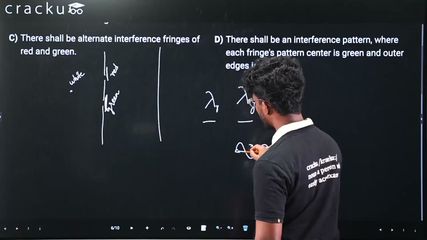
In a Young's double slit experiment, the source is white light. One of the slits is covered by red filter and another by a green filter. In this case
For sustained interference in Young’s double-slit experiment, the two light waves reaching a point on the screen must satisfy two basic conditions:
• They must have the same (or almost the same) frequency / wavelength.
• They must maintain a constant phase difference.
If the source is white light and both slits are uncovered, every wavelength from the same source reaches both slits, so corresponding components of each wavelength are coherent and an interference pattern is obtained (central white fringe, coloured side fringes).
In the present situation one slit is covered with a red filter while the other is covered with a green filter. Hence:
• The light emerging from slit $$S_1$$ is almost monochromatic red with wavelength say $$\lambda_r$$.
• The light emerging from slit $$S_2$$ is almost monochromatic green with wavelength say $$\lambda_g$$, where $$\lambda_g \neq \lambda_r$$.
Therefore the two beams that superpose on the screen have different frequencies $$\nu_r$$ and $$\nu_g$$. The phase difference between them changes continuously with time because
$$\text{Phase difference} = 2\pi\bigl(\nu_r - \nu_g\bigr)t + \text{(constant path term)}$$
Since $$\nu_r \neq \nu_g$$, the term $$2\pi\bigl(\nu_r - \nu_g\bigr)t$$ varies rapidly; the phase relation is not stable. Time-averaged (detector) intensity at any point becomes simply the sum of individual intensities:
$$I = I_r + I_g$$
No position on the screen receives a consistently larger or smaller resultant amplitude, so bright and dark bands cannot form. Each slit only produces its own single-slit diffraction envelope; the two envelopes just overlap without producing any alternating maxima and minima.
Hence no interference fringes are observed.
Correct option: Option B
Was this solution helpful?
Click on the Email ☝️ to Watch the Video Solution
Create a FREE account and get:
_1.webp)

Educational materials for JEE preparation

Ask our AI anything

AI can make mistakes. Please verify important information.
AI can make mistakes. Please verify important information.
