
Join Our JEE Preparation Group
Prep with like-minded aspirants; Get access to free daily tests and study material.
Sign in
Please select an account to continue using cracku.in
↓ →
Join Our JEE Preparation Group
Prep with like-minded aspirants; Get access to free daily tests and study material.
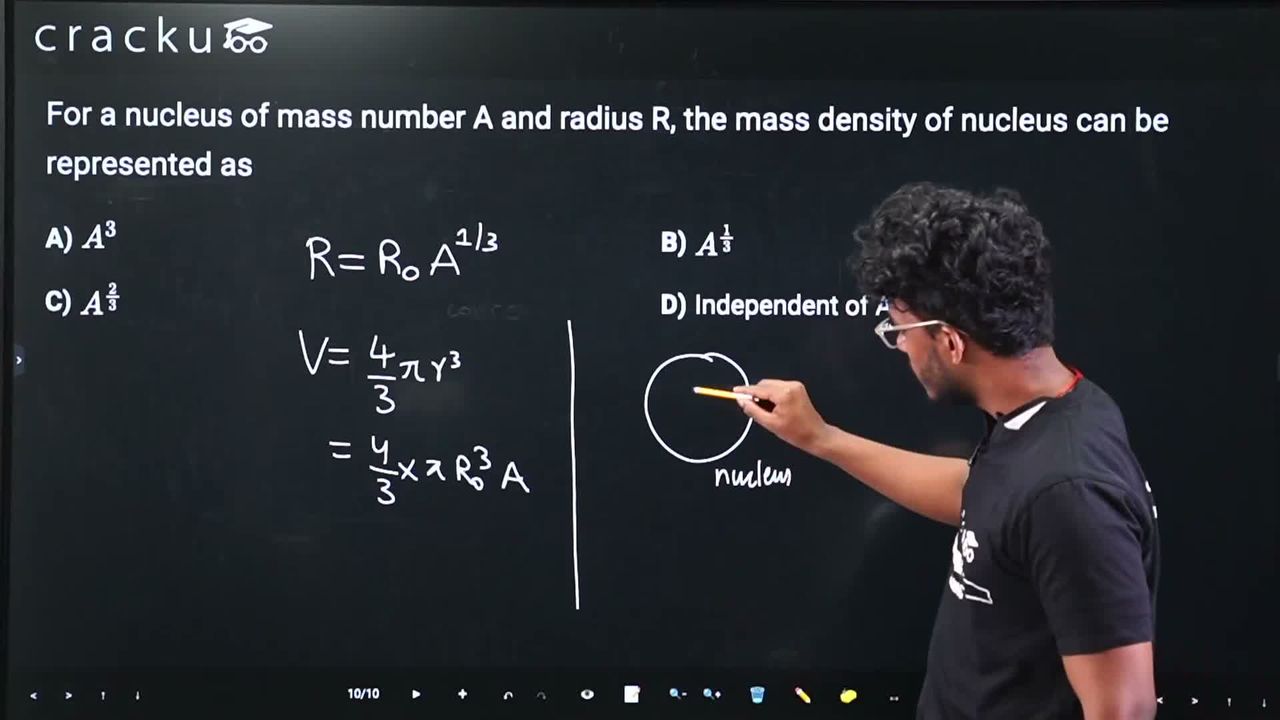
For a nucleus of mass number A and radius R, the mass density of nucleus can be represented as
The nucleus is assumed to be a uniform solid sphere.
Radius-mass number relation:
Experimental data give $$R = R_0\,A^{1/3}$$, where $$R_0 \approx 1.2 \times 10^{-15}\,\text{m}$$.
Volume of the nucleus:
$$V = \frac{4}{3}\pi R^{3}$$
Substitute $$R = R_0\,A^{1/3}$$:
$$V = \frac{4}{3}\pi \left(R_0\,A^{1/3}\right)^{3} = \frac{4}{3}\pi R_0^{3}\,A$$ $$-(1)$$
Mass of the nucleus:
Each nucleon (proton or neutron) has nearly the same mass $$m_N$$, so for mass number $$A$$ the nuclear mass is approximately
$$M \approx A\,m_N$$ $$-(2)$$
Nuclear mass density $$\rho$$ is defined as mass per unit volume:
$$\rho = \frac{M}{V}$$
Insert $$(1)$$ and $$(2)$$:
$$\rho = \frac{A\,m_N}{\dfrac{4}{3}\pi R_0^{3}\,A} = \frac{3\,m_N}{4\pi R_0^{3}}$$
The factor $$A$$ cancels out; therefore $$\rho$$ does not depend on the mass number $$A$$.
Hence, the nuclear mass density is independent of A.
Correct option: Option D.
Click on the Email ☝️ to Watch the Video Solution
Create a FREE account and get:
_1.webp)

Educational materials for JEE preparation

Ask our AI anything

AI can make mistakes. Please verify important information.
AI can make mistakes. Please verify important information.


