
Join Our JEE Preparation Group
Prep with like-minded aspirants; Get access to free daily tests and study material.
Sign in
Please select an account to continue using cracku.in
↓ →
Join Our JEE Preparation Group
Prep with like-minded aspirants; Get access to free daily tests and study material.
The cyanide ion is an:
$$\mathrm{Ambidentate\ Nucleophile}$$
It can attack through either:
$$\mathrm{Carbon}$$
or
$$\mathrm{Nitrogen}$$
When ethyl chloride reacts with:
$$\mathrm{AgCN}$$
the product formed is different from that obtained with:
$$\mathrm{NaCN}$$
Silver cyanide is predominantly covalent.
Hence, the carbon atom remains strongly bonded to silver, and the nitrogen atom attacks the alkyl halide.
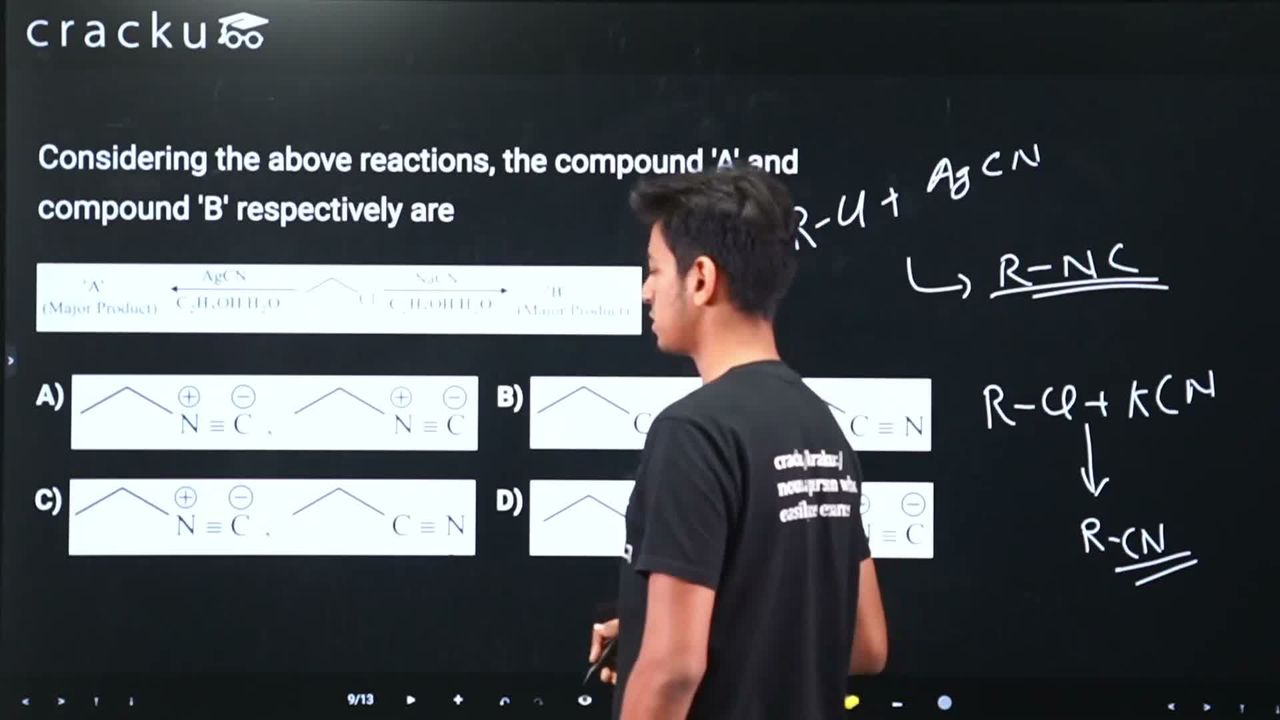
$$\mathrm{CH_3CH_2Cl + AgCN \longrightarrow CH_3CH_2NC + AgCl}$$
Thus, compound $$\mathrm{A}$$ is:
$$\mathrm{Ethyl\ Isocyanide\ (CH_3CH_2NC)}$$
Sodium cyanide is ionic and dissociates completely to give free:
$$\mathrm{CN^-}$$
ions.
Attack occurs mainly through carbon because formation of a:
$$\mathrm{C-C}$$
bond is more stable.
$$\mathrm{CH_3CH_2Cl + NaCN \longrightarrow CH_3CH_2CN + NaCl}$$
Thus, compound $$\mathrm{B}$$ is:
$$\mathrm{Ethyl\ Cyanide\ (CH_3CH_2CN)}$$
also called:
$$\mathrm{Propanenitrile}$$
Thus, the right option is C.
Was this solution helpful?
Click on the Email ☝️ to Watch the Video Solution
Create a FREE account and get:
_1.webp)

Educational materials for JEE preparation

Ask our AI anything

AI can make mistakes. Please verify important information.
AI can make mistakes. Please verify important information.

