
Join Our JEE Preparation Group
Prep with like-minded aspirants; Get access to free daily tests and study material.
Sign in
Please select an account to continue using cracku.in
↓ →
Join Our JEE Preparation Group
Prep with like-minded aspirants; Get access to free daily tests and study material.
The point of intersection and sudden increase in the slope, in the diagram given below, respectively, indicates:
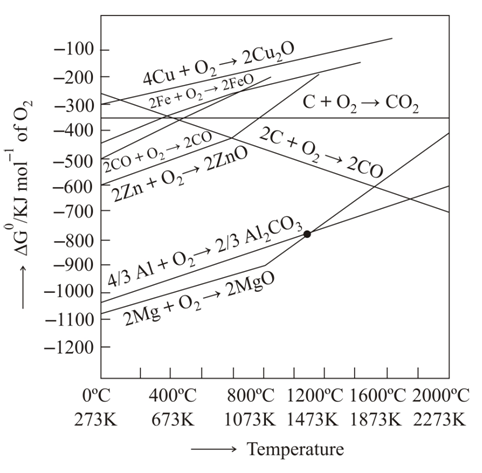
In an Ellingham diagram, the vertical axis represents $$\mathrm{\Delta G^\circ}$$ for oxide formation, while temperature is plotted on the horizontal axis.
Point of intersection of two lines indicates the temperature at which the standard Gibbs free energies of formation of both oxides become equal.
At this temperature:
$$\mathrm{\Delta G = 0}$$
for the corresponding reduction reaction, and the system is at equilibrium.
For example, at the intersection of the Mg and $$\mathrm{Al_2O_3}$$ lines, neither metal can reduce the oxide of the other.
Below this temperature, the metal represented by the lower line can reduce the oxide represented by the upper line.
The slope of an Ellingham line is equal to:
$$\mathrm{-\Delta S^\circ}$$
A sudden increase in slope indicates that $$\mathrm{\Delta S^\circ}$$ has become more negative.
This occurs when the metal undergoes a phase transition such as:
$$\mathrm{Melting\ (s \rightarrow l)}$$
or
$$\mathrm{Vaporisation\ (l \rightarrow g)}$$
Thus:
1. Point of intersection indicates $$\mathrm{\Delta G = 0}$$ for the reduction reaction.
2. Sudden increase in slope indicates phase change of the metal.
Was this solution helpful?
Click on the Email ☝️ to Watch the Video Solution
Create a FREE account and get:
_1.webp)

Educational materials for JEE preparation

Ask our AI anything

AI can make mistakes. Please verify important information.
AI can make mistakes. Please verify important information.
